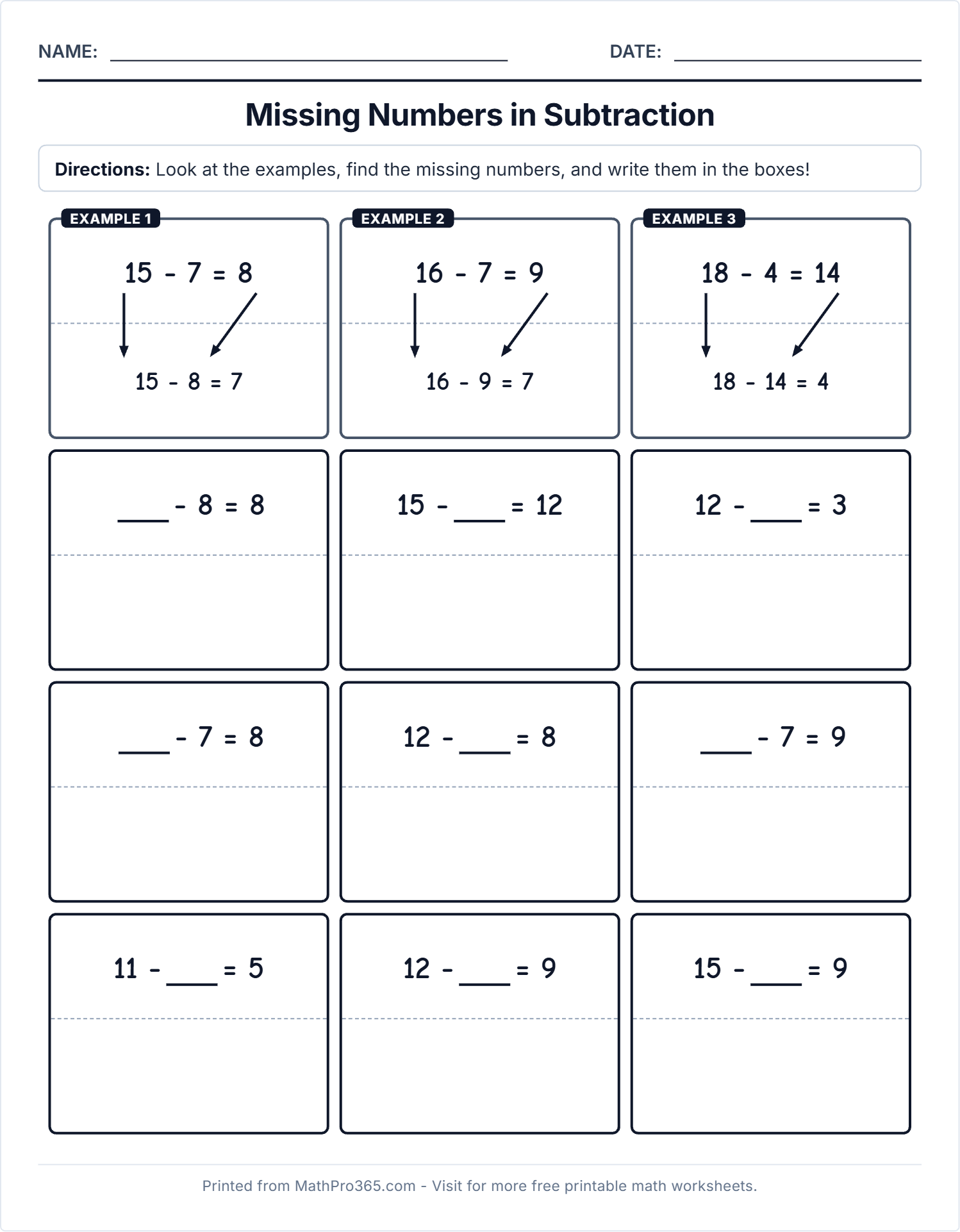
Missing Numbers in Subtraction Grade 1 Free PDF
Updated: October 2026
Practice missing numbers in subtraction with this Grade 1 worksheet featuring simple subtraction equations within 20. Students build number sense and strengthen subtraction fact fluency by finding the missing values.
More Subtraction Worksheets (Grade 1) →Missing Numbers in Subtraction Worksheets for Grade 1
Early subtraction lessons are about much more than finding the answer to a math problem. Children also need to understand how numbers are connected. Missing numbers in subtraction activities encourage that kind of thinking by asking learners to figure out an unknown value instead of solving a standard subtraction equation. This extra step helps first graders develop stronger reasoning skills while becoming more comfortable with numbers.
Designed for subtraction within 20, this Grade 1 printable gives children opportunities to solve equations such as 15 − □ = 12, □ − 8 = 8, and 12 − □ = 3. Rather than guessing, they learn to think about how subtraction works and how each number in an equation relates to the others. Regular practice builds confidence and makes subtraction facts easier to remember.
Looking Beyond the Answer
Many young learners first see subtraction as simply taking away. Missing number problems introduce a broader way of thinking. Instead of asking, "What is the answer?" children begin asking questions like, "What number belongs here?" or "What number did I start with?"
Take the equation:
12 − □ = 3
A child might think, "How much do I subtract from 12 to end with 3?" Some students count backward, while others remember related addition facts. Both strategies help them discover that the missing number is 9.
Now consider:
□ − 7 = 8
This time the starting number is unknown. Counting forward from 8 by seven more leads to 15, showing that the missing number must be 15. Experiences like these help children realize that subtraction is about understanding number relationships, not simply following steps.
Why This Math Skill Is Important
Finding missing numbers strengthens more than subtraction facts. It encourages logical thinking and helps children recognize how numbers fit together. Instead of relying only on memorization, they begin making sense of each equation.
As students grow more comfortable with these problems, they also begin connecting subtraction and addition. That connection becomes increasingly valuable in later grades when they encounter larger numbers, word problems, fact families, and even introductory algebra concepts.
A child who understands that subtraction can help find a missing number is building mathematical thinking that will support future learning across many topics.
Growing Strong Number Sense
Number sense develops gradually through meaningful practice. Missing number subtraction exercises encourage children to look carefully at each equation and decide which strategy makes the most sense.
Working with numbers up to 20 gives first graders plenty of opportunities to recognize patterns, compare quantities, and improve mental math skills.
For example:
16 − □ = 9
Some children immediately know the missing number is 7. Others may check by asking themselves, "What number plus 9 equals 16?" Both methods reinforce the relationship between addition and subtraction.
Over time, this flexible thinking helps students solve problems more efficiently and with greater confidence.
Skills Children Practice
- Understanding subtraction within 20.
- Recognizing number relationships.
- Developing logical reasoning.
- Strengthening mental math.
- Using more than one solving strategy.
- Checking work independently.
- Building confidence with equations.
Helpful Ways to Solve Missing Number Problems
There is no single correct strategy for every child. Encouraging different approaches helps learners discover methods that feel natural while improving problem-solving flexibility.
Count Backward
For an equation like 11 − □ = 5, children can count backward from 11 until they reach 5. The number of jumps tells them the missing value.
Count Forward
Sometimes it is easier to begin with the answer.
Example:
12 − □ = 8
Count from 8 up to 12:
9, 10, 11, 12
Since four numbers were counted, the missing number is 4.
Think About Addition
Subtraction and addition belong to the same fact family.
For example:
- 7 + 8 = 15
- 15 − 7 = 8
- 15 − 8 = 7
Recognizing these related facts often makes missing number equations much easier to solve.
Use Pictures or Counters
Hands-on learning remains one of the best ways for first graders to understand math. Drawing simple pictures or using counters allows children to see exactly what happens when numbers are taken away.
Ideas for Classroom Practice
This printable works well during many parts of the school day. It fits naturally into math centers, morning work, independent practice, small-group instruction, intervention lessons, or homework assignments.
A teacher might begin by solving a few examples together before asking children to complete the remaining problems independently. As students work, encourage them to explain their thinking instead of simply sharing an answer.
Pair discussions also make excellent learning opportunities. One child may solve a problem by counting backward, while another uses addition. Comparing strategies helps everyone see that there is often more than one effective way to solve a math problem.
Supporting Small Groups
Children who need additional guidance often benefit from concrete materials. Counters, connecting cubes, number lines, or ten frames can make subtraction relationships much easier to understand.
Suppose students solve:
15 − □ = 9
Starting with 15 counters and removing them until only 9 remain gives children a visual way to see that 6 counters were taken away. Concrete experiences like this build understanding before students rely on mental math alone.
Practicing at Home
Learning doesn't have to stop after school. Everyday activities provide plenty of chances to reinforce subtraction in simple, meaningful ways.
Imagine a child has 12 crackers and eats some for a snack. If 5 crackers remain, ask:
"How many crackers did you eat?"
The child is solving:
12 − □ = 5
Toys, books, blocks, fruit, pencils, or coins can all become useful math tools. These short conversations help children see that subtraction appears in daily life.
Even five or ten minutes of practice several times each week can improve fluency and build confidence.
Common Mistakes Young Learners Make
Every new math concept comes with a learning curve. Understanding common errors makes it easier to provide helpful support during classroom instruction, intervention, homeschooling, or homework.
Rushing Without Reading the Equation
Some children immediately subtract the visible numbers without thinking about what the missing box represents. Encouraging them to read the entire equation before solving helps prevent this habit.
Thinking the Blank Is Always the Answer
Because many subtraction problems place the answer after the equals sign, students sometimes expect every blank to belong there. Practicing equations with the missing number in different positions encourages more flexible thinking.
Counting Mistakes
Young learners occasionally skip numbers while counting backward or forward. A number line, counters, or fingers can provide extra support until counting becomes more automatic.
Extending the Learning
Children who finish early can continue strengthening their subtraction skills with activities that encourage deeper thinking.
- Create five new missing number subtraction problems.
- Write the matching addition fact for each equation.
- Model one problem using counters or drawings.
- Explain how you found each missing number.
- Challenge a partner to solve your equations.
These simple extension activities work well during math centers, enrichment time, or independent practice.
Encouraging Math Conversations
Talking about math is just as valuable as writing answers. Children develop stronger reasoning skills when they explain their thinking out loud.
Questions like these encourage meaningful discussion:
- How did you figure out the missing number?
- Could you solve it a different way?
- Which strategy worked best for you?
- How does addition help you solve subtraction problems?
- How can you check that your answer is correct?
These conversations help teachers, tutors, and parents better understand how children are thinking while giving students practice using mathematical vocabulary.
Preparing for Future Math Success
Although these subtraction problems use numbers within 20, the thinking behind them prepares children for much more advanced mathematics. Finding unknown numbers appears later in multi-step word problems, measurement, fractions, multiplication, division, and early algebra.
When first graders learn to see equations as balanced relationships instead of simple calculations, they develop habits that support future problem solving. Building this understanding now creates a strong foundation for every new math skill that follows.
Frequently Asked Questions
What is the best way to introduce missing number subtraction?
Start with hands-on materials like counters or blocks before moving to written equations. Concrete examples help children understand what each number represents.
Can children use addition to solve subtraction problems?
Yes. Thinking about the related addition fact is one of the most effective strategies for solving missing number subtraction equations.
How can I make subtraction practice more engaging?
Use everyday objects, simple games, partner activities, or short challenges. Keeping practice fun encourages children to stay interested while improving their skills.
How often should first graders practice subtraction within 20?
Brief practice sessions several times each week are usually enough to strengthen subtraction fluency. Regular review helps children remember facts and become more confident over time.
Download and Print
This Grade 1 missing numbers in subtraction worksheet offers meaningful practice with subtraction within 20 while strengthening number sense, reasoning, and problem-solving skills. It works well for classroom lessons, math centers, morning work, intervention groups, independent practice, homework, and homeschooling. Print the worksheet whenever your young mathematicians need extra subtraction practice, and watch their confidence grow as they become more comfortable solving missing number equations.
Worksheet Preview
Today's Challenge
Frequently Asked Questions
Who is this worksheet for?
This worksheet is designed for Grade 1 students practicing subtraction skills.
Can I print this worksheet?
Yes. The worksheet is available as a printable PDF download.
Can teachers use this worksheet in class?
Yes. Teachers, homeschool users and parents can use it for classroom practice and homework.
Related Worksheets
Find Missing Numbers in Subtraction Worksheet Grade 1 Free PDF
Find Missing Numbers in Subtraction Grade 1 Free PDF
Missing Numbers in Subtraction Worksheet for Grade 1
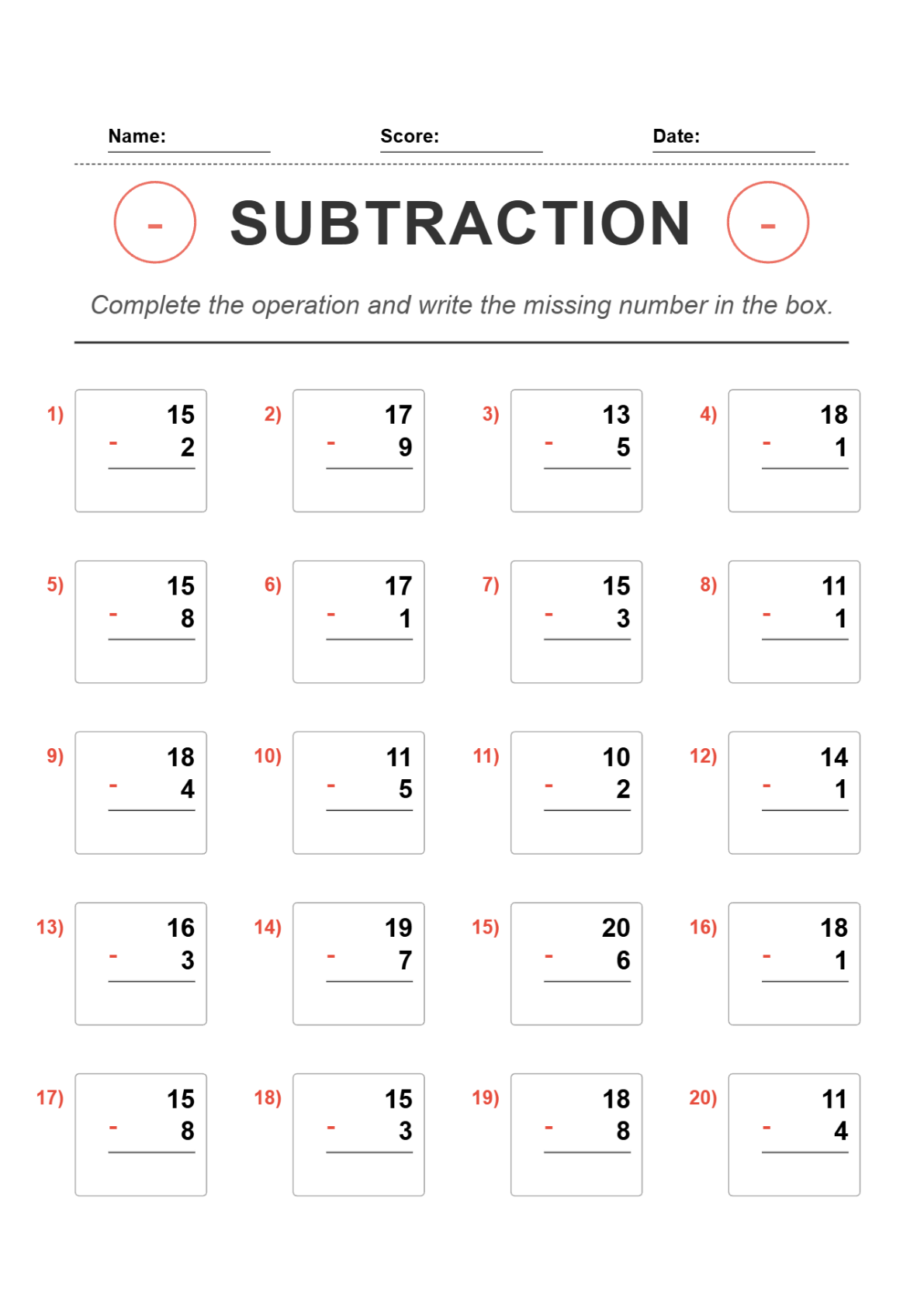
Subtraction Within 20 Worksheets (Grade 1) – Free Printable PDF
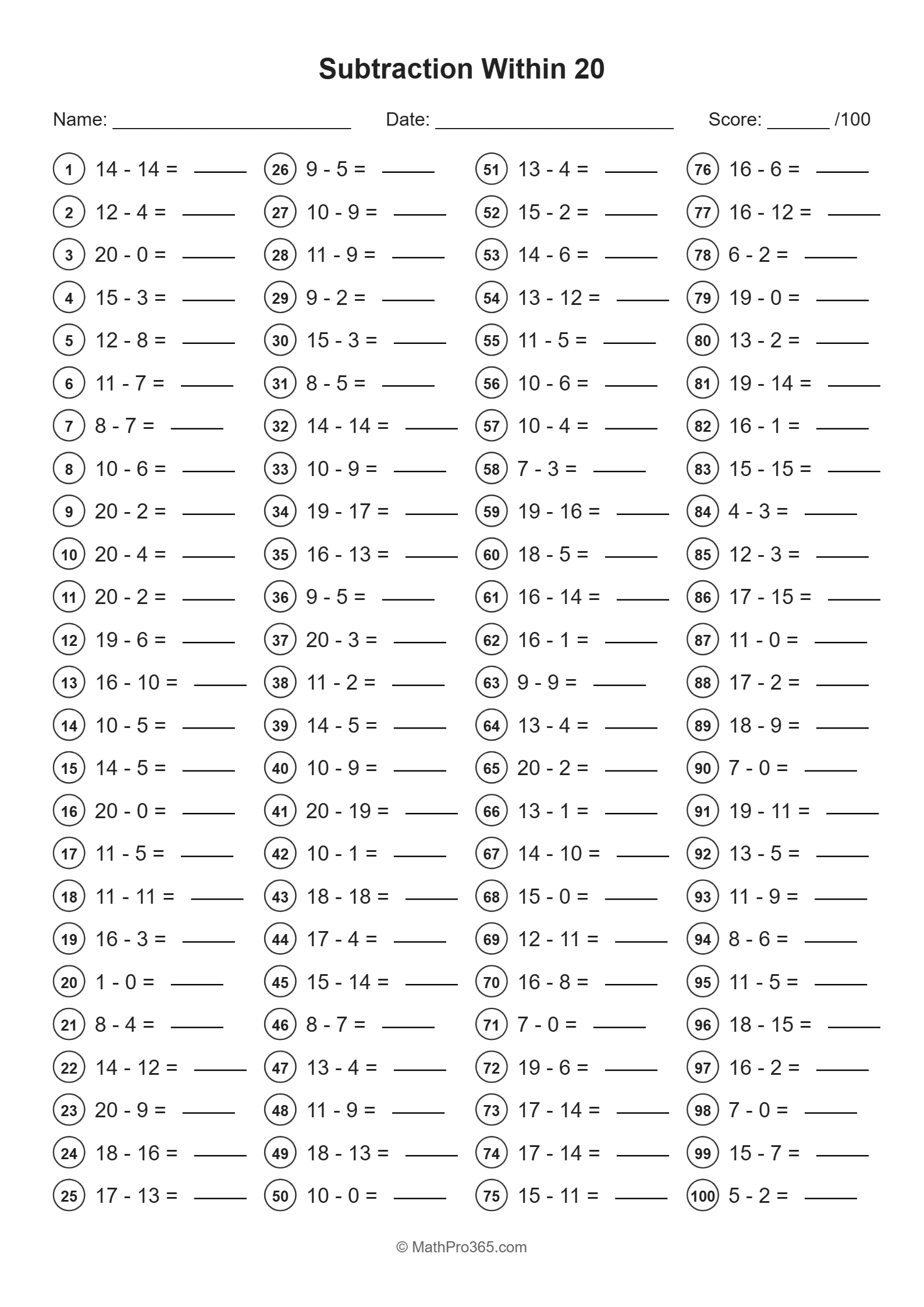
Subtraction Within 20 Grade 1 Free PDF
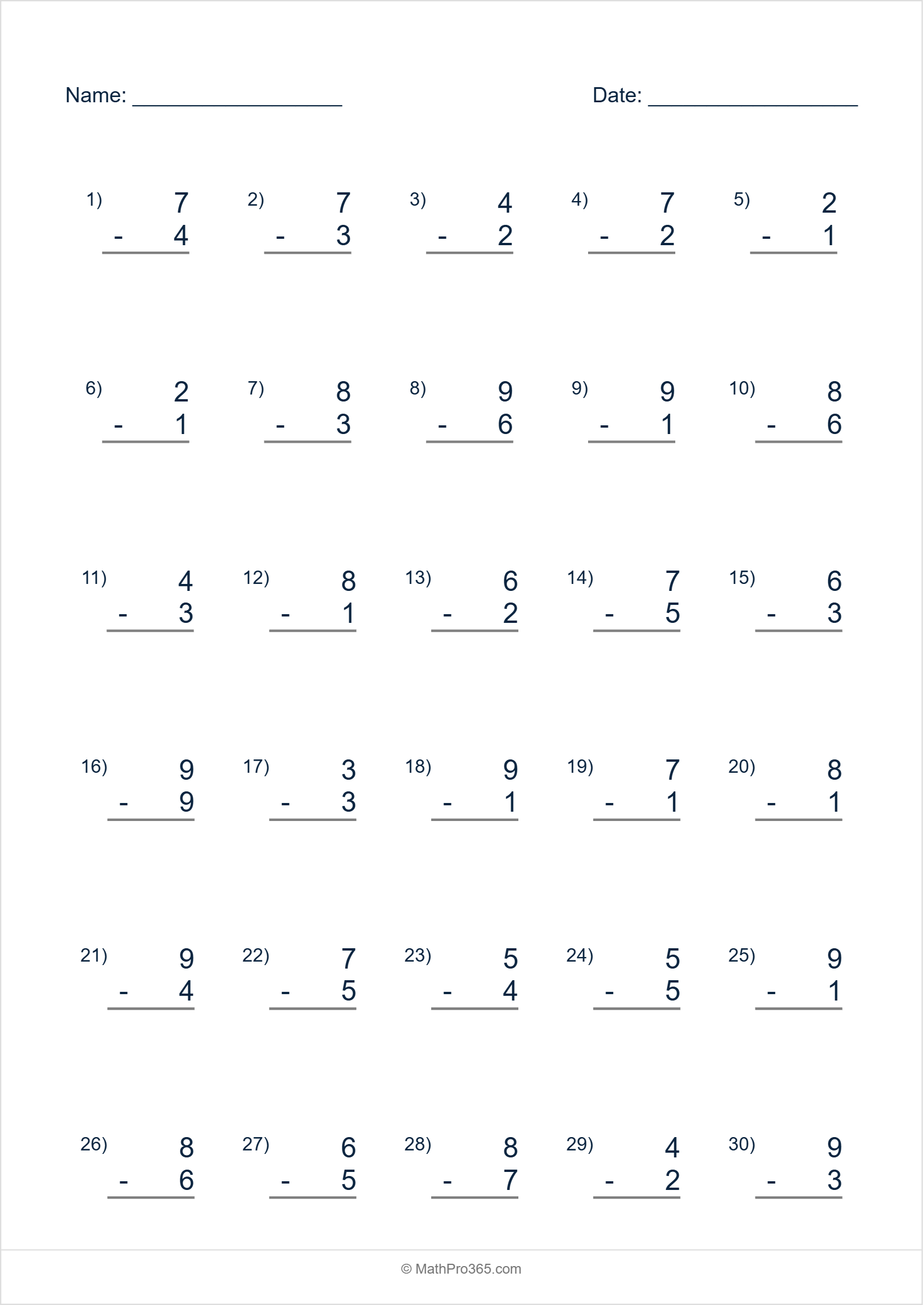
1 Digit (1-9) Minus 1 Digit (1-9) Subtraction Worksheet Grade 1 Sheet 2 Free PDF
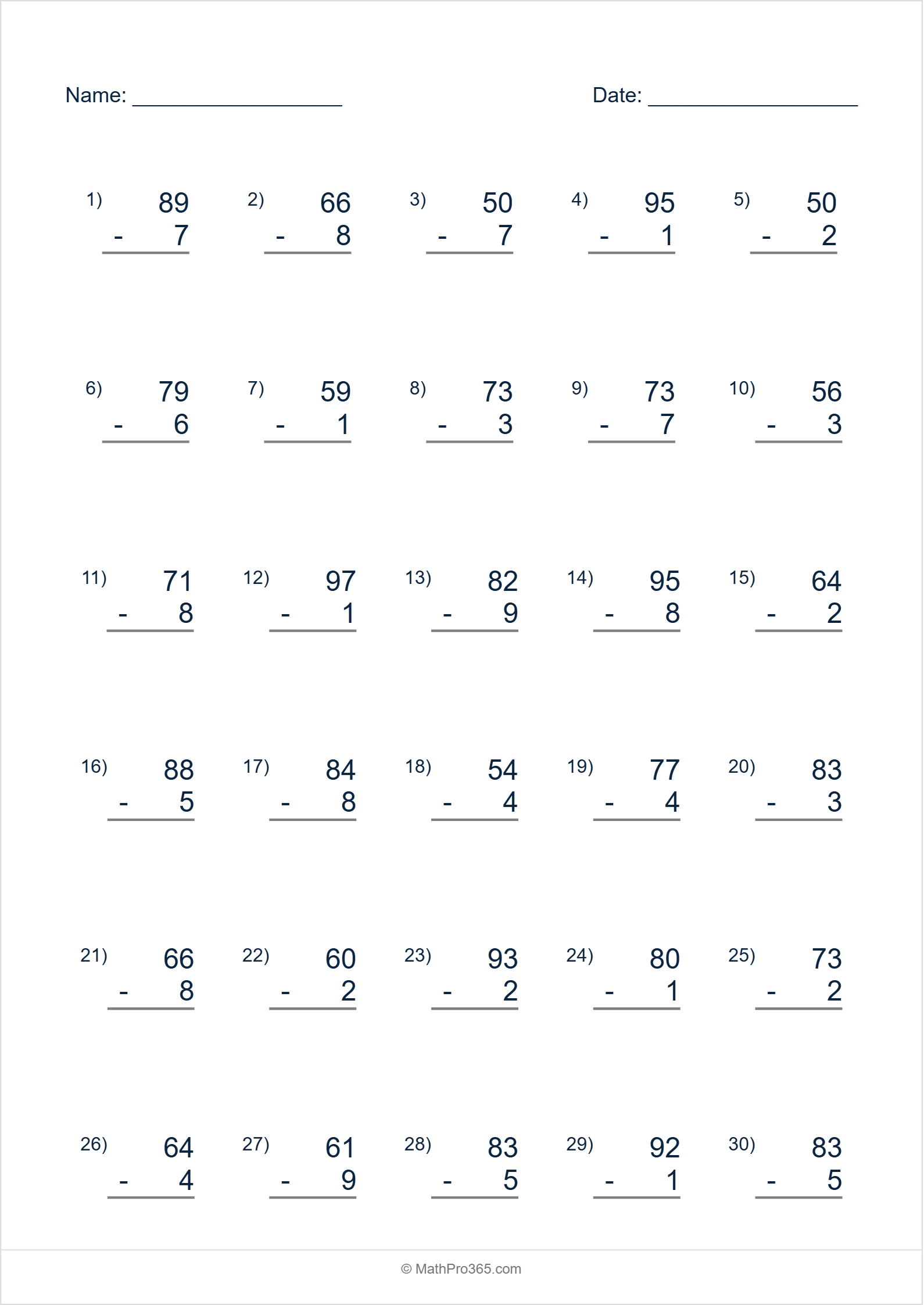
2 Digit (50-99) Minus 1 Digit (1-9) Subtraction Worksheet Grade 1 Sheet 2 Free PDF
Subtraction Within 30 – No Regrouping (Grade 1) – Free PDF
2 Digit Subtraction Without Regrouping Grade 1 Worksheet Free PDF
Subtraction Within 10 – 30 Basic Problems (Grade 1) – Free PDF
Interactive worksheets can be customized before downloading.