Draw Objects Counting Numbers Worksheet Grade 1 Free PDF
Updated: October 2026
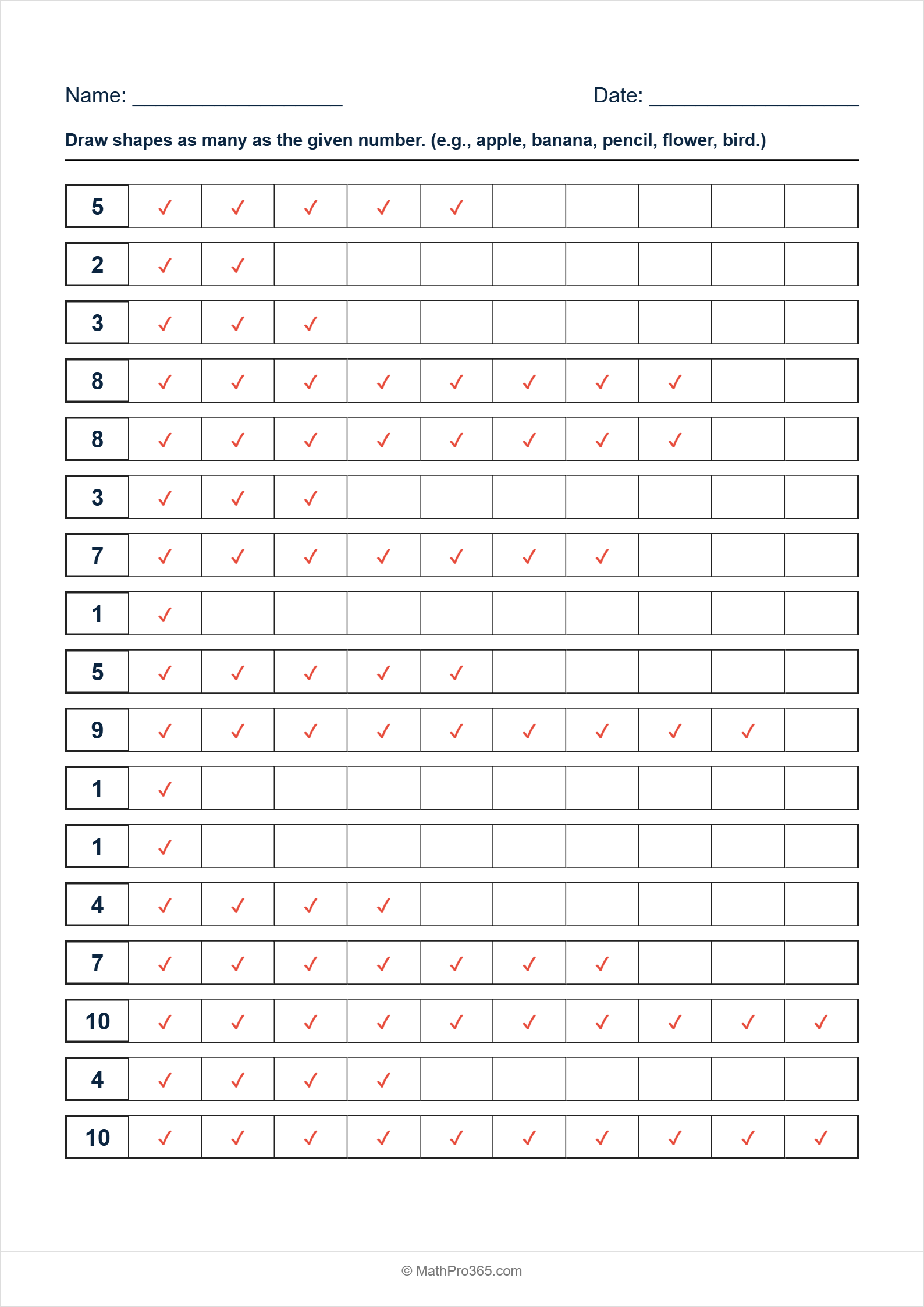
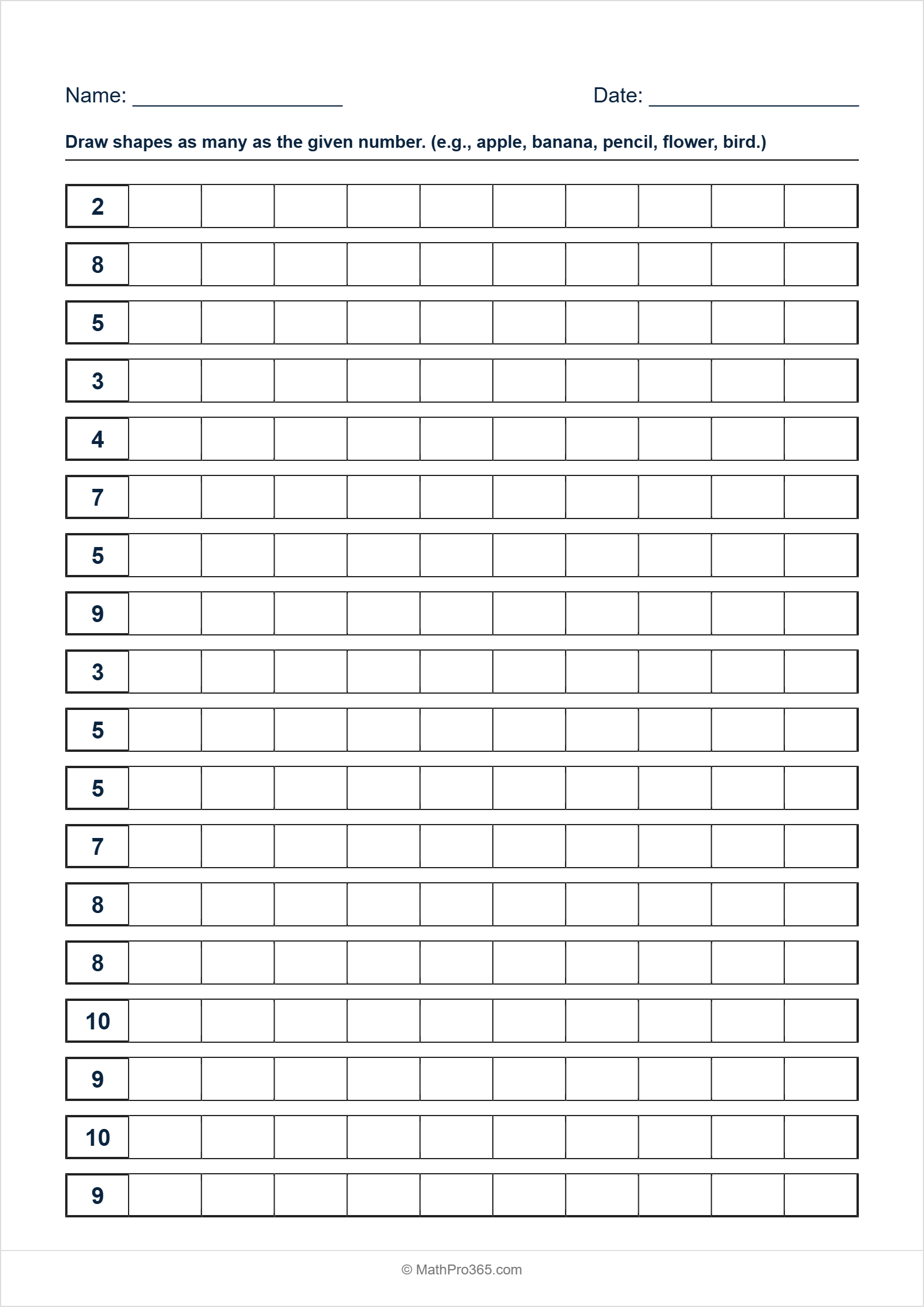
This Grade 1 worksheet helps children practice counting by drawing the correct number of objects for each given number from 1 to 10. It strengthens number recognition, counting skills, and early math confidence.
More Draw Objects Worksheets (Grade 1) →Helping Children Build Number Sense by Drawing Objects
Young learners develop strong math foundations when they connect numbers with real quantities. A Draw Objects Counting Numbers Worksheet gives first-grade students an engaging way to practice this important skill by drawing the correct number of pictures that match each number. Instead of simply recognizing numerals, children actively represent numbers using objects such as apples, flowers, stars, pencils, or animals. This visual approach helps students understand that every number represents an exact amount.
In this worksheet, students work with numbers from 1 to 10, making it ideal for beginning mathematicians. As they draw each group of objects, they strengthen counting skills, improve one-to-one correspondence, and gain confidence recognizing quantities. These activities encourage careful observation while making early math enjoyable and interactive.
Understanding Numbers Through Pictures
Children often learn best when they can see and create visual models. Drawing objects transforms abstract numbers into meaningful groups that are easy to understand.
For example:
- The number 2 becomes two balloons.
- The number 5 becomes five flowers.
- The number 7 becomes seven birds.
- The number 10 becomes ten stars.
Each drawing reinforces that the numeral always represents the same quantity regardless of the objects chosen. Whether students draw five apples or five pencils, they learn that the value remains five.
Why Drawing Objects Supports Early Math Learning
Representing numbers with pictures develops several important mathematical skills at the same time. Students are not only practicing counting but also learning how numbers relate to real-world collections.
This type of worksheet encourages children to:
- Count accurately from 1 through 10.
- Match numerals with quantities.
- Practice careful observation.
- Develop fine motor control through drawing.
- Increase concentration during independent work.
- Build confidence in early math activities.
Because children create the pictures themselves, they become active participants in the learning process instead of simply identifying printed images.
Building One-to-One Correspondence
One-to-one correspondence is one of the most important counting skills taught in Grade 1. It means every object counted receives exactly one number word.
For example, if a student draws six butterflies, they should point to each butterfly while counting:
One, two, three, four, five, six.
Skipping an object or counting one picture twice leads to incorrect totals. Practicing this skill regularly helps students become more accurate and prepares them for future addition and subtraction lessons.
Everyday Opportunities to Practice Counting
Counting appears throughout a child's daily routine. Parents and teachers can reinforce worksheet skills by encouraging children to count familiar objects around them.
Examples include:
- Count four crayons before starting art.
- Draw three clouds during outdoor observation.
- Count seven toy cars before putting them away.
- Draw eight fish in an imaginary aquarium.
- Count two shoes before getting dressed.
- Draw nine leaves collected during a nature walk.
Connecting numbers to everyday experiences makes counting meaningful and memorable.
Skills Developed Beyond Counting
Although the primary goal is learning numbers from 1 to 10, this worksheet strengthens many additional abilities that support overall academic growth.
- Visual discrimination
- Hand-eye coordination
- Pencil control
- Attention to detail
- Listening to directions
- Independent thinking
- Organization
- Patience while completing tasks
These developmental skills benefit children across multiple subjects, including reading, writing, science, and art.
Encouraging Creative Thinking
Unlike worksheets with only one correct picture, drawing activities allow students to make creative choices while still demonstrating mathematical understanding.
A child asked to draw eight objects might choose:
- Eight flowers
- Eight stars
- Eight cookies
- Eight balloons
- Eight ladybugs
Each answer is mathematically correct because the quantity matches the given numeral. This flexibility encourages creativity while reinforcing counting accuracy.
Ideas for Classroom Learning Centers
This worksheet works well in math centers where students rotate through different activities. Teachers can provide colored pencils, crayons, or markers to make the experience more engaging.
Possible center activities include:
- Draw different animals for each number.
- Use seasonal themes such as pumpkins, snowflakes, or flowers.
- Choose classroom supplies like pencils or books.
- Create favorite food collections.
- Draw objects found in nature.
Changing themes keeps counting practice fresh throughout the school year.
Supporting Learning at Home
Families can use this worksheet to reinforce classroom instruction without requiring special materials. Most activities need only a pencil and imagination.
Parents might ask questions such as:
- "Can you draw five apples?"
- "What happens if we add one more flower?"
- "Can you count your drawings again?"
- "Which number was easiest?"
- "Can you draw ten different objects?"
Simple conversations encourage children to explain their thinking, strengthening both math vocabulary and communication skills.
Common Challenges Students May Face
Beginning learners often make small counting mistakes while completing drawing activities. Recognizing these errors helps adults provide effective guidance.
- Drawing too many objects.
- Drawing too few objects.
- Losing track while counting.
- Counting one picture twice.
- Writing the wrong numeral next to drawings.
- Skipping numbers while counting aloud.
Encourage children to recount every group after finishing. This simple habit greatly improves accuracy.
Extending the Activity Beyond the Worksheet
Once students complete the worksheet, teachers and parents can introduce additional challenges using the same counting concepts.
Extension ideas include:
- Color every second object.
- Circle the largest group.
- Compare which number has more objects.
- Find the smallest collection.
- Draw one extra object and recount.
- Erase one object and count again.
These follow-up activities naturally introduce comparison, greater than, less than, and simple addition or subtraction concepts.
Observation and Assessment Opportunities
Drawing activities allow teachers to observe much more than correct answers. Students demonstrate how they think about numbers while working independently.
Educators can assess whether children:
- Recognize numerals from 1 through 10.
- Understand one-to-one correspondence.
- Count objects accurately.
- Maintain organization on the page.
- Self-correct mistakes.
- Complete tasks independently.
These observations help teachers identify students who may benefit from additional counting practice.
Connecting to Future Math Skills
Representing numbers with drawings lays the groundwork for many future mathematical concepts. Children who understand quantities are better prepared for addition, subtraction, place value, measurement, and problem solving.
For example, once students confidently draw six objects, they can easily explore questions like:
- What if one more object is added?
- How many remain if two are removed?
- Which group has more objects?
- Which group has fewer?
These simple extensions gradually introduce mathematical reasoning while keeping learning developmentally appropriate.
Frequently Asked Questions
Should children count aloud while drawing?
Yes. Saying each number aloud while drawing helps strengthen one-to-one correspondence and reduces counting mistakes.
Can students draw different kinds of objects for the same number?
Absolutely. As long as the total matches the numeral, children can draw any combination of appropriate objects that interests them.
How often should this type of counting activity be practiced?
Short practice sessions several times each week are usually more effective than completing many pages at once.
What if a child finishes the worksheet quickly?
Invite the student to create additional number groups, compare quantities, or explain how they counted each collection to reinforce understanding.
Download and Print
This printable Draw Objects Counting Numbers Worksheet for Grade 1 provides an enjoyable way to practice counting numbers from 1 to 10 through creative drawing activities. It supports number recognition, one-to-one correspondence, fine motor development, and early mathematical thinking in both classroom and home learning environments. Download and print the worksheet to give young learners meaningful hands-on practice that builds confidence and prepares them for future math success.
Worksheet Preview
Today's Challenge
Frequently Asked Questions
Who is this worksheet for?
This worksheet is designed for Grade 1 students practicing draw-objects skills.
Can I print this worksheet?
Yes. The worksheet is available as a printable PDF download.
Can teachers use this worksheet in class?
Yes. Teachers, homeschool users and parents can use it for classroom practice and homework.
Related Worksheets
Interactive worksheets can be customized before downloading.