Continue the Number Sequence Grade 1 Free PDF
Updated: October 2026
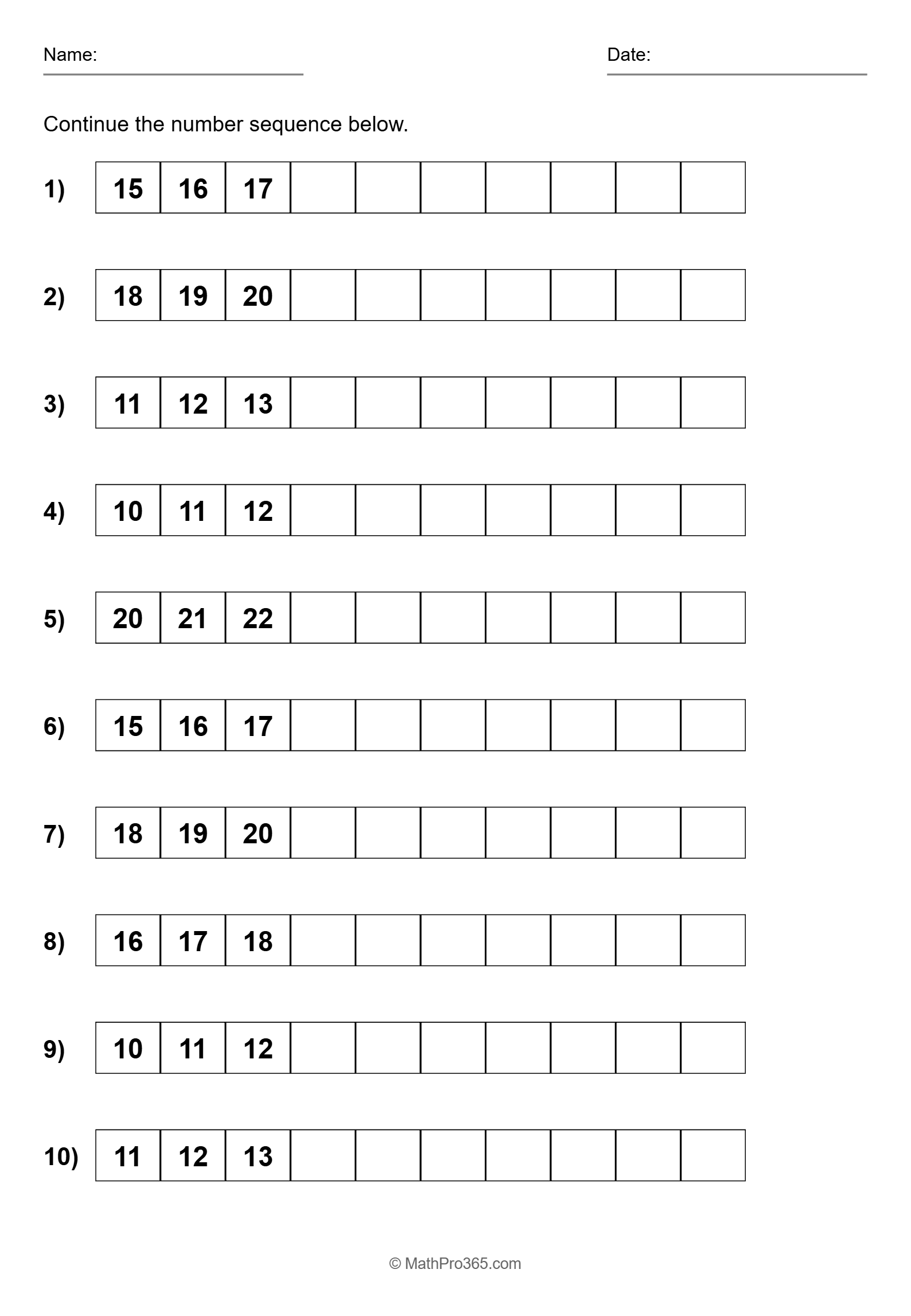
Help young learners practice completing basic counting patterns with this printable number sequence worksheet. Perfect for 1st grade students building foundational math skills.
More Number Sequence Worksheets (Grade 1) →Understanding Number Sequences in First Grade
Learning to identify, follow, and complete number sequences is one of the most fundamental milestones in early elementary mathematics. When first graders look at a series of numbers like 10, 11, and 12, they are doing far more than simply reading digits off a page. They are recognizing predictable patterns, analyzing numerical progression, and solidifying their mental representation of quantity. Mastering simple sequential order sets the groundwork for addition, subtraction, place value, and higher-level problem-solving that students will encounter throughout their academic journey.
For young children, numbers begin as separate, isolated symbols. Through structured practice with sequential sequences, these isolated numbers begin to connect into a cohesive, structured line. A solid grasp of how numbers increase step-by-step builds the flexible math thinking required to tackle multi-digit operations, skip counting, and mental arithmetic down the road.
What Is a Sequential Number Sequence?
A sequential sequence is a linear arrangement of numbers governed by a consistent rule. In early primary grades, this rule usually involves adding one to the preceding digit to find the next term. When working within the 10 to 30 range, children transition from basic single-digit counting into the teen and early twenty ranges, where number patterns repeat in predictable cycles.
Consider the following examples commonly found on beginner sequence worksheets:
- Example 1: 15, 16, 17, ___, ___, ___ → Child counts forward by ones: 18, 19, 20.
- Example 2: 18, 19, 20, ___, ___, ___ → Child crosses the decade threshold: 21, 22, 23.
- Example 3: 11, 12, 13, ___, ___, ___ → Child continues the pattern: 14, 15, 16.
Why Number Progression Matters for Early Learners
Developing fluency with number order directly supports early number sense—the intuitive understanding of what numbers mean and how they relate to one another. When children instantly know that 18 comes immediately after 17, they spend less cognitive energy on basic counting and can focus on more complex mathematical concepts.
Furthermore, recognizing sequential order helps prevent common foundational misunderstandings. Early learners frequently struggle when transitioning across decade barriers, such as moving from 19 to 20 or from 29 to 30. Repeated practice with linear sequences helps children visualize how the units reset to zero while the tens place increases by one, demystifying the base-ten numbering system.
Building Mental Line Visualization
Worksheets that feature linear sequences provide a physical representation of an internal mental number line. As children move from left to right across blank boxes, filling in missing terms, they reinforce the concept that moving right means values are increasing. This left-to-right processing mirrors reading direction in Western languages, creating a comfortable, intuitive layout for early readers who are learning to apply structural rules to math tasks.
Effective Teaching Strategies for Sequence Mastery
Introducing number sequences successfully requires a thoughtful blend of hands-on exploration, verbal counting, and structured written practice. Educators and caregivers can use several practical strategies to help young learners build confidence and accuracy.
1. Concrete to Abstract Progression
Before asking children to fill out paper worksheets, begin with physical manipulatives. Unifix cubes, counting bears, or ten-frames allow students to physically feel and see quantities growing larger by one item each step. Have students build a tower of 10 blocks, then 11, then 12, noticing how each step up is taller by exactly one block. Once the concrete relationship is established, move to pictorial visuals before transitioning to abstract numerical worksheets.
2. Choral Counting and Auditory Rhythm
Many children are auditory learners who benefit from hearing and reciting sequences aloud. Rhythm and tempo play a significant role in memory retention. Incorporate physical movements—such as clapping, stomping, or tapping desks on each count—as children chant number series together. Stopping the chant mid-stream and asking a student to name the very next number builds real-time predictive skills.
3. Utilizing Number Line References
For children who hesitate or feel overwhelmed by blank boxes, provide a visual desktop number line ranging from 1 to 30. Encourage them to place a finger on the starting number given in the problem, say the number aloud, and step their finger forward to determine the missing values. Over time, as recognition improves, fade the use of the visual aid to encourage mental recall.
Addressing Common Student Misconceptions
Even with careful instruction, young mathematicians frequently encounter specific hurdles when filling in sequential patterns. Identifying these common errors early allows teachers and parents to provide targeted support.
Transitioning Across Tens (Decade Obstacles)
The most frequent error occurs when a sequence crosses a ten-digit boundary, such as moving from 19 to 20. A student might correctly write 17, 18, 19, but then pause and write 10 or 191 because the pattern shift feels unfamiliar. To address this, emphasize decade transitions using place value blocks, highlighting how nine single units become a brand-new group of ten.
Reversing Digits
First graders are still developing spatial orientation, making digit reversals like writing 12 as 21 or 17 as 71 very common. When a child writes 21 instead of 12 in a sequence like 10, 11, ___, point out the tens place first to help them self-correct without feeling discouraged.
Losing Track of the Sequence Step
Sometimes young children accidentally jump a number when filling out multiple consecutive blank boxes—writing 15, 16, 17, 18, 20, 21 (skipping 19). Encouraging students to touch each box with their pencil and count out loud as they write dramatically reduces simple oversight mistakes.
Flexible Ways to Use This Printable Worksheet
This worksheet is designed to fit seamlessly into a wide variety of educational environments, whether you are managing a busy classroom, running a targeted intervention group, or teaching at home.
In the Elementary Classroom
- Morning Work: Warm up student brains at the start of the school day with a quick, approachable sequence activity that reinforces independent work habits.
- Math Centers: Place printed sheets inside dry-erase sleeves with fine-tip markers for a reusable, low-prep station activity during guided math rotations.
- Formative Assessment: Use a completed page as a quick check for understanding to identify which students need extra support with place value or decade shifts.
In Homeschool and Tutoring Settings
- One-on-One Guided Practice: Sit alongside your learner, asking them to explain their thinking out loud as they complete each row: "How did you know 21 came after 20?"
- Intervention & Remediation: For older students who struggle with foundational math skills, this straightforward, distraction-free format helps rebuild number order confidence without feeling babyish.
- Home-School Connection: Send pages home as stress-free homework that parents can easily understand, oversee, and celebrate.
Connecting Sequences to Broader Math Skills
Mastering basic sequential patterns creates direct pathways toward more advanced primary math standards. Understanding how numbers link together opens the door to multiple core competencies:
Skip Counting and Multiplication Foundations
Once a student reliably understands counting forward by ones, transitioning to counting by twos, fives, and tens becomes much smoother. Skip counting is essentially just an adjusted sequence rule (e.g., +2 or +5 instead of +1), which forms the conceptual groundwork for early multiplication.
Addition as "Counting On"
Sequential order is the engine behind the "counting on" strategy used in addition. When solving a problem like 12 + 3, students who possess strong sequence fluency do not need to count from 1. They start at 12 and seamlessly count three steps forward in the sequence: 13, 14, 15.
Understanding Greater Than and Less Than
Sequences reinforce positional order. Children learn that numbers appearing further to the right in a sequence represent greater quantities, while numbers to the left represent lesser values, solidifying comparison skills (>, <, =).
Frequently Asked Questions
What grade level is this number sequence worksheet intended for?
This worksheet is primarily designed for Kindergarten (advanced) through 1st Grade students. It is ideal for children working on number recognition, counting forward from any given number, and mastering quantities between 10 and 30.
How can I help a student who gets stuck crossing from 19 to 20?
Use concrete visual tools like place value charts or ten-frames. Show them that 19 is made of 1 ten and 9 ones. Adding one more piece fills the frame, turning 9 ones into 1 new ten, giving us 2 tens (20). Practicing decade transitions verbally before writing also helps build confidence.
Is this worksheet suitable for students with learning differences or ADHD?
Yes. The clean, uncluttered box format offers visual clarity, reducing sensory overload. The predictable structure helps students maintain focus on one line at a time without feeling overwhelmed by dense text or overly decorative elements.
Can this worksheet be used for skip counting practice?
While this specific sheet focuses on counting forward by ones (+1 sequence), you can easily modify the instructions for advanced learners by asking them to create their own skip-counting rules or use the starting numbers to count by twos with teacher guidance.
Download and Print
Ready to strengthen your student's foundational math skills? Download and print this free high-quality math worksheet PDF today. Designed for clean printing in black and white, it provides clear, clutter-free practice that supports number sense development in classroom workstations, homeschool lessons, and after-school homework routines. Simply click the link, save to your computer, and print as many copies as you need for your learners!
Worksheet Preview
Today's Challenge
Frequently Asked Questions
Who is this worksheet for?
This worksheet is designed for Grade 1 students practicing number-sequence skills.
Can I print this worksheet?
Yes. The worksheet is available as a printable PDF download.
Can teachers use this worksheet in class?
Yes. Teachers, homeschool users and parents can use it for classroom practice and homework.
Related Worksheets
Number Sequence Counting by 2 Worksheet Grade 1 Free PDF
Continue the Number Sequence: Grade 1 Counting Worksheet
Grade 1 Counting & Drawing Shapes Math Worksheet
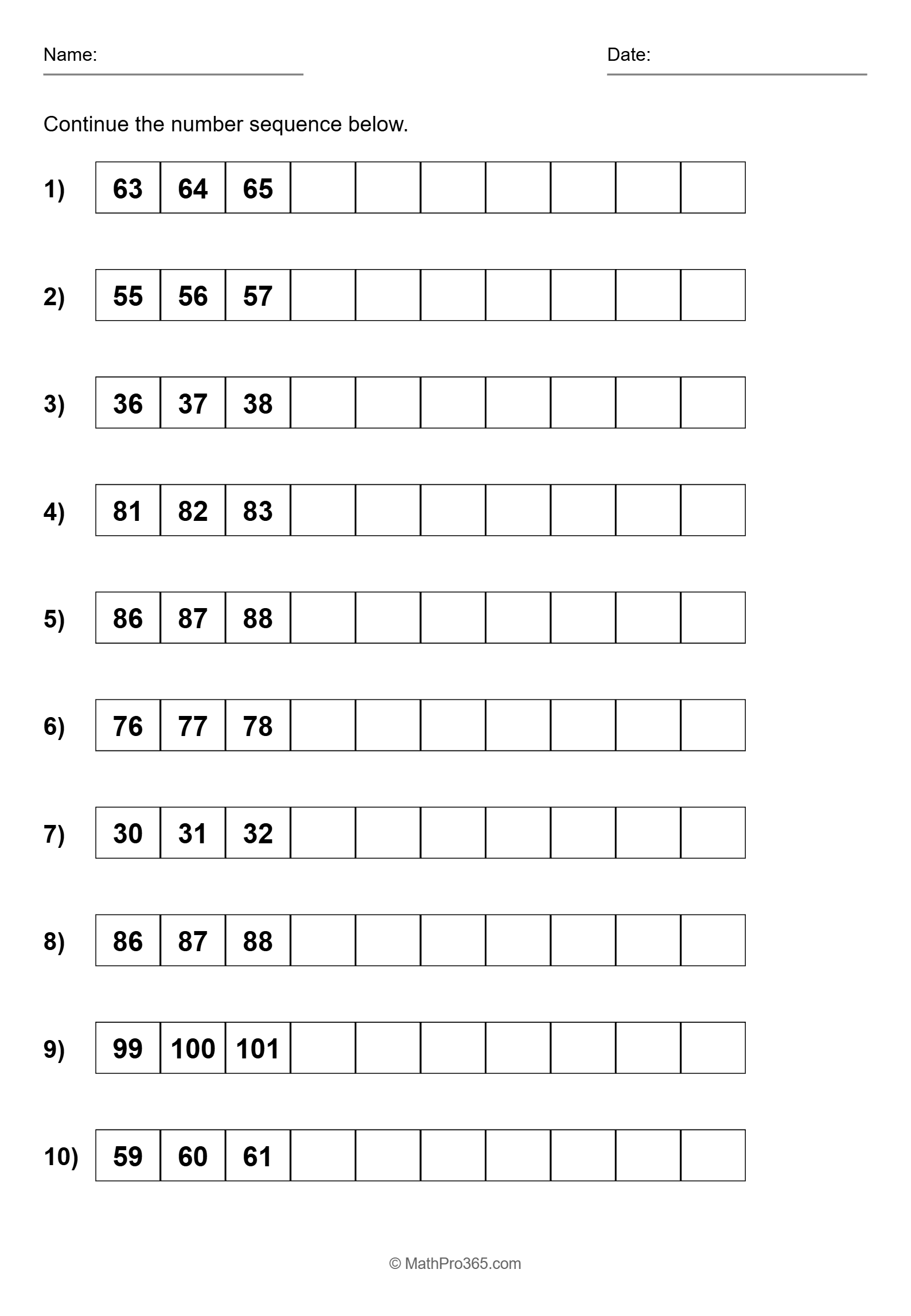
Number Sequence Counting by 1 Worksheet Grade 1 Free PDF
Before and After Numbers Within 100 Worksheet Grade 1 Free PDF
Before and After Number Sequences Worksheet - Grade 1
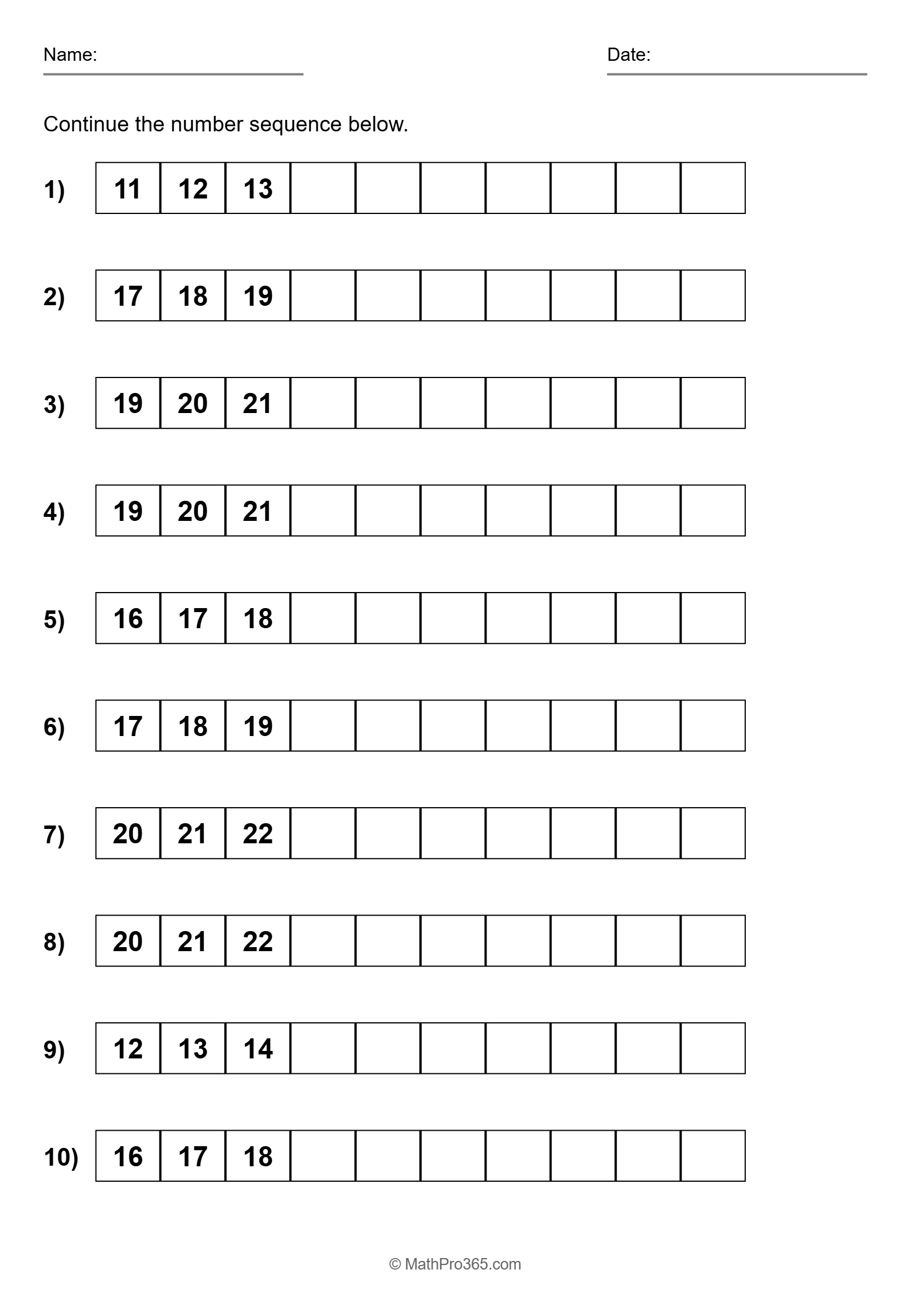
Counting Forward by 1 Number Sequences Worksheet Grade 1 Free PDF
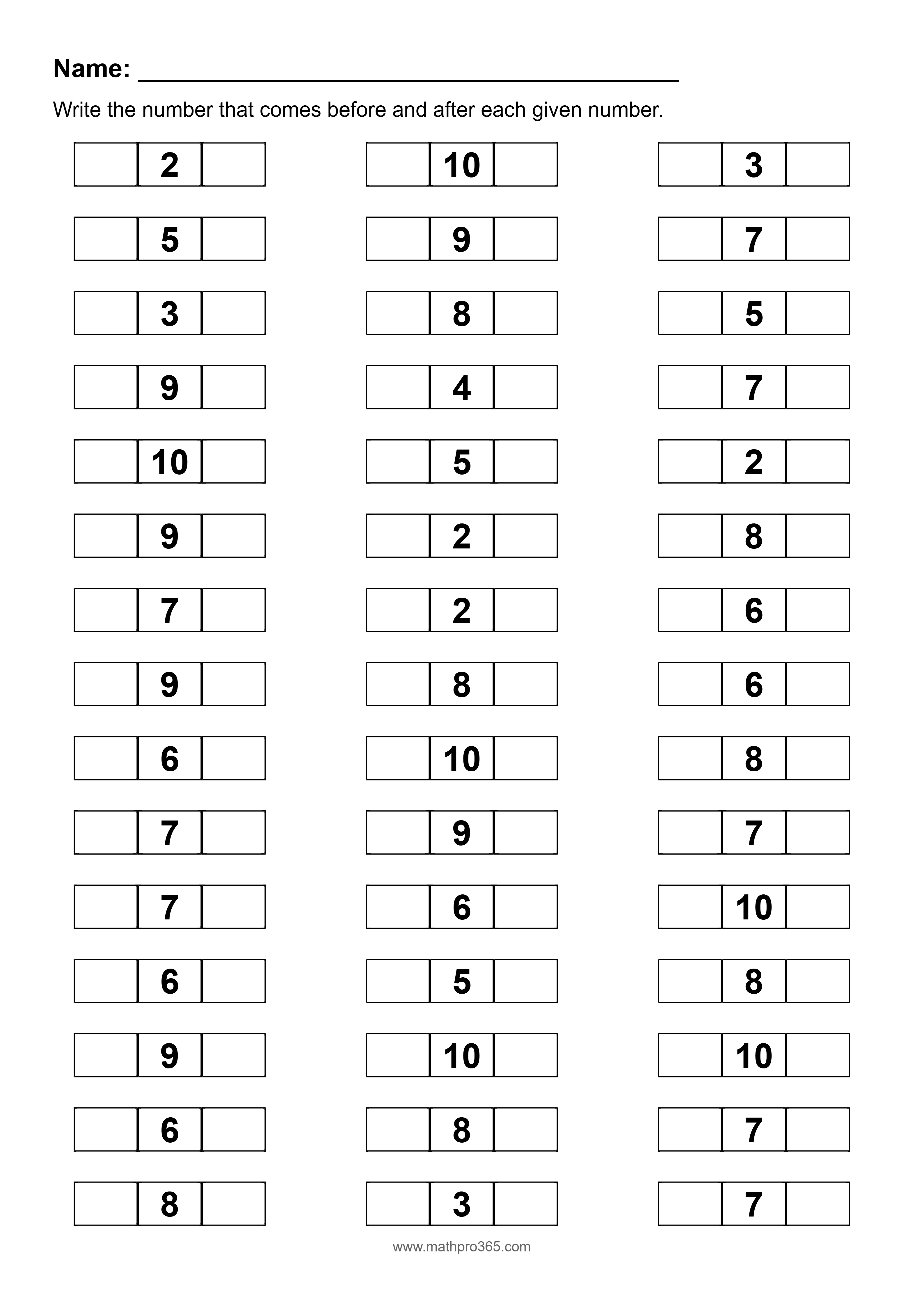
Grade 1 Before and After Numbers Math Worksheet
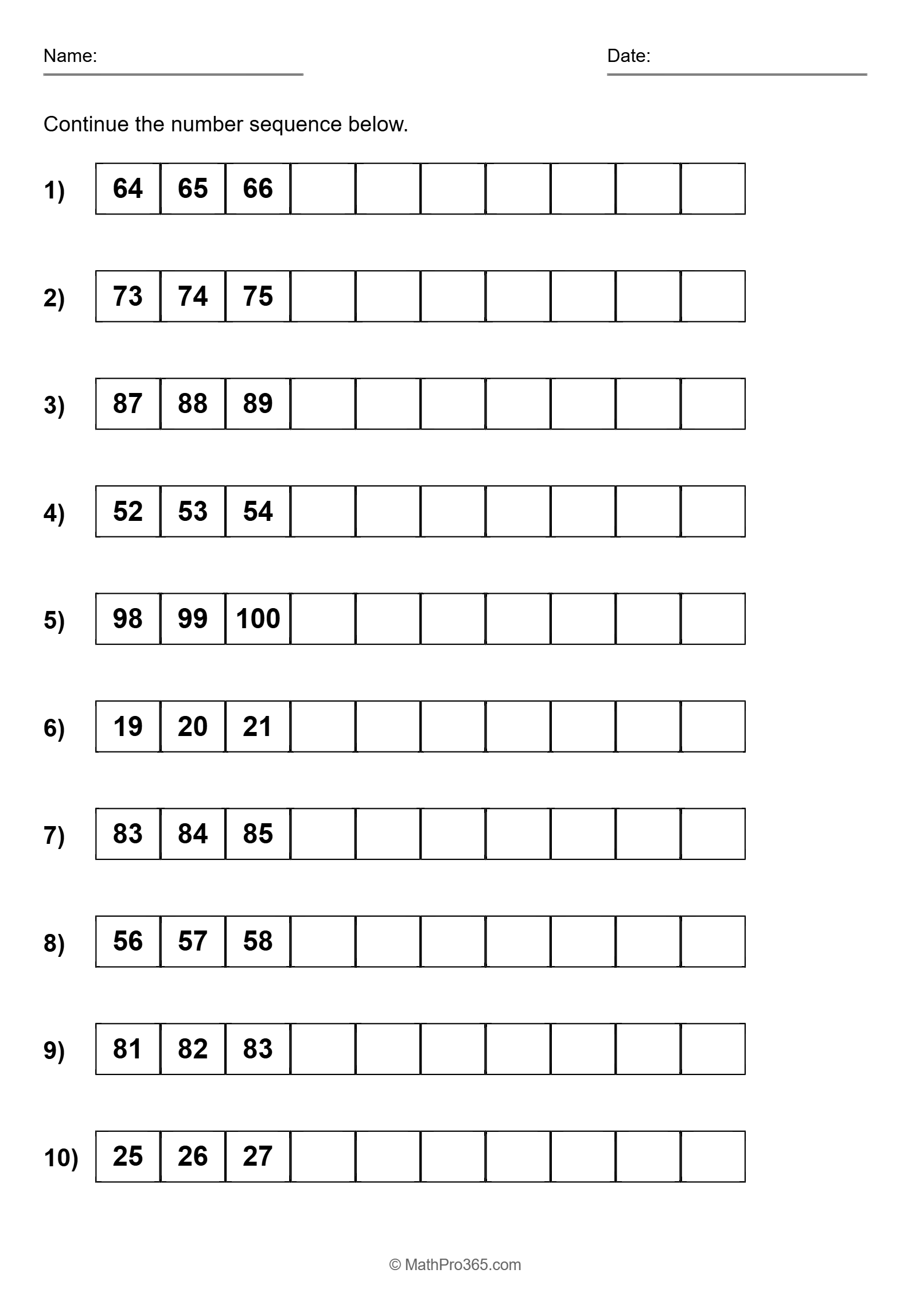
Grade 1 Counting Sequences: Number Patterns to 100
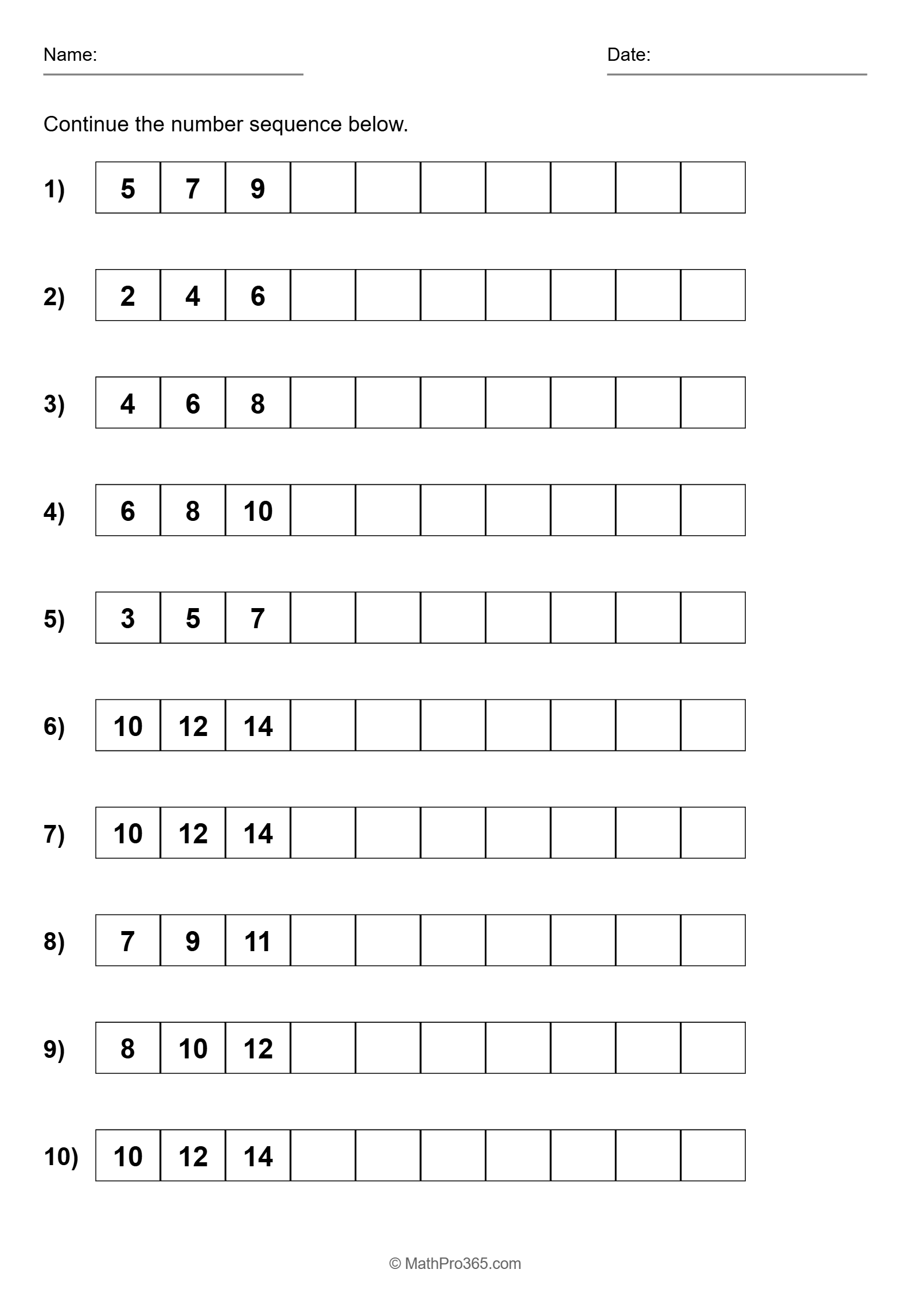
Addition Number Sequences Skip Counting by 2 Grade 1 Free PDF
Interactive worksheets can be customized before downloading.