2-Digit Subtraction Without Regrouping Grade 1 Free PDF
Updated: October 2026
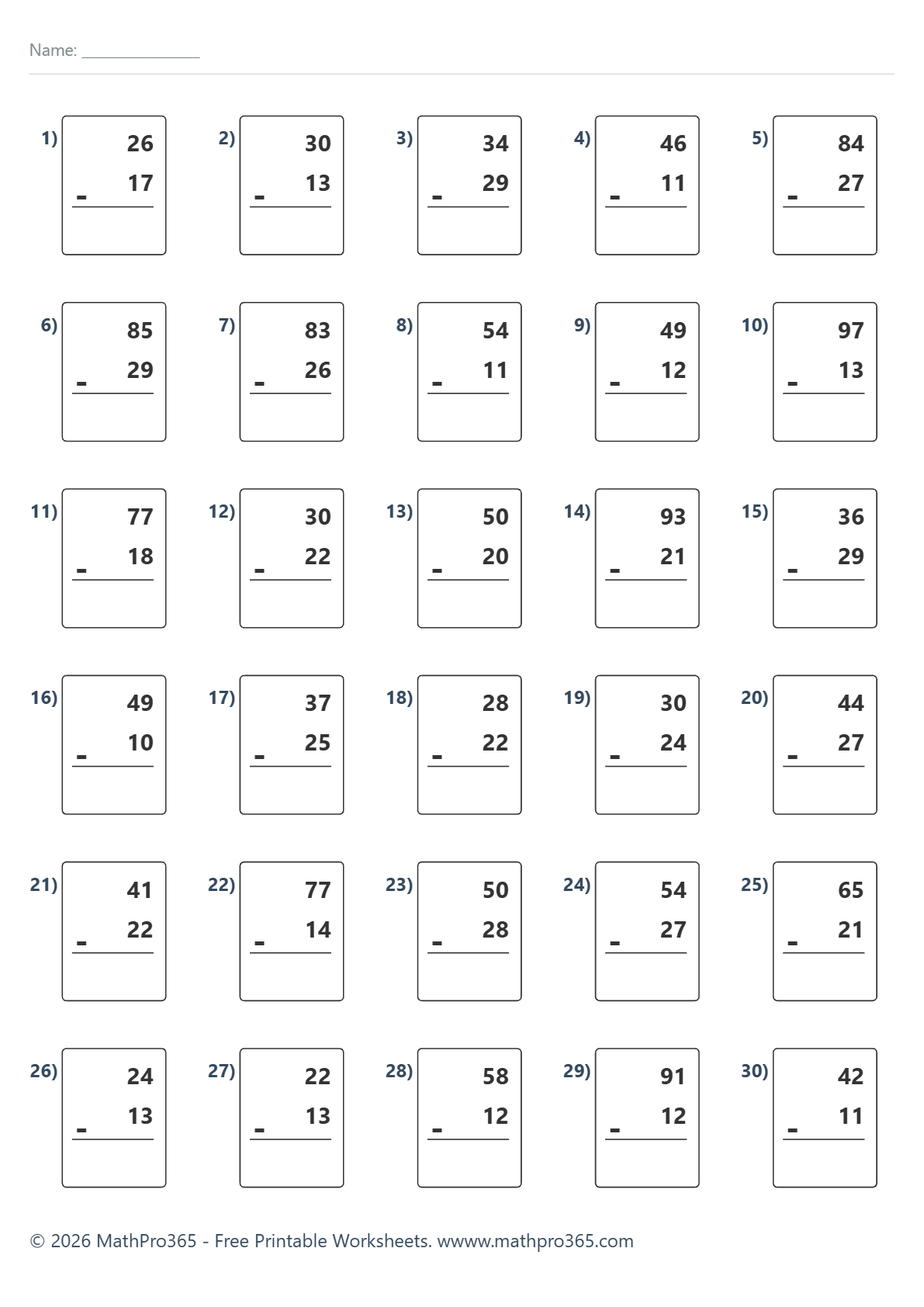
Practice basic 2-digit subtraction without regrouping with 30 printable problems designed for Grade 1 students. This free PDF worksheet helps build subtraction fluency and confidence through simple vertical subtraction exercises.
More Subtraction Worksheets (Grade 2) →Mastering 2-Digit Subtraction Without Regrouping
Learning subtraction is an exciting milestone in elementary mathematics because it helps children understand how numbers relate to one another. This worksheet focuses on 2-digit subtraction without regrouping, giving young learners plenty of opportunities to practice solving vertical subtraction problems where each digit in the minuend is greater than or equal to the corresponding digit in the subtrahend. Since no borrowing is required, students can concentrate on understanding place value, building confidence, and improving calculation accuracy.
Each problem encourages children to subtract the ones first and then the tens. For example, in the equation 54 − 21, students subtract 4 − 1 to get 3 and then 5 tens − 2 tens to get 3 tens, resulting in the answer 33. This straightforward process helps establish a strong foundation before introducing more advanced subtraction strategies.
Building Strong Place Value Understanding
Place value is one of the most important concepts in early mathematics. Every two-digit number is made up of tens and ones, and understanding this structure makes subtraction much easier.
Consider the number 83. It contains 8 tens and 3 ones. When subtracting 83 − 21, students recognize that they are removing 2 tens and 1 one. Because each column can be solved independently, the calculation becomes simple:
- Ones: 3 − 1 = 2
- Tens: 8 − 2 = 6
- Answer: 62
Repeated exposure to problems like these strengthens number sense and prepares children for more complex subtraction involving regrouping in future lessons.
Learning Goals for This Worksheet
Students completing this worksheet have the opportunity to:
- Practice subtracting two-digit numbers without borrowing.
- Strengthen understanding of tens and ones.
- Develop careful alignment of numbers in vertical format.
- Increase subtraction fluency.
- Improve mathematical accuracy and confidence.
- Recognize subtraction as finding the difference between two numbers.
Simple Steps for Solving Each Problem
Following a consistent routine helps children solve subtraction problems correctly.
- Look at the ones column.
- Subtract the bottom digit from the top digit.
- Move to the tens column.
- Subtract the tens.
- Write the final answer.
For example, solve 65 − 21:
- 5 − 1 = 4
- 6 − 2 = 4
- Final answer: 44
Using the same sequence every time helps students become faster while reducing mistakes.
Why Practicing Without Regrouping Is Important
Beginning with subtraction problems that do not require regrouping allows children to focus on understanding the operation itself. Instead of worrying about borrowing, students can build confidence by mastering one skill at a time.
As learners become comfortable solving problems such as 46 − 11 or 77 − 14, they develop automaticity with basic subtraction facts and become more prepared for future lessons that introduce regrouping.
Frequent practice also strengthens mental math skills because children begin recognizing patterns within numbers.
Helpful Mental Strategies
Although students often solve these problems vertically, mental strategies can also support learning.
- Think in tens first.
- Subtract the ones separately.
- Estimate the answer before solving.
- Check whether the result is reasonable.
For example, before solving 91 − 12, students might estimate that the answer will be close to 80. After calculating 79, they can see that the answer makes sense.
Everyday Uses of Subtraction
Subtraction appears throughout daily life, making this skill useful well beyond the classroom.
Children might use subtraction when:
- Counting how many stickers remain after sharing some.
- Finding how many pages are left in a book.
- Determining how many toys are still in a basket.
- Calculating how many minutes remain before an activity begins.
- Comparing two scores in a game.
Connecting subtraction to familiar situations helps students understand why mathematics matters.
Examples Students Can Practice
Here are several examples similar to those found on this worksheet.
- 42 − 11 = 31
- 58 − 12 = 46
- 77 − 18 = 59
- 93 − 21 = 72
- 50 − 20 = 30
- 84 − 27 = 57
Working through examples like these reinforces the standard subtraction process while improving accuracy.
Common Errors and How to Prevent Them
Young mathematicians often make predictable mistakes when learning subtraction. Identifying these errors early helps students become more successful.
Misaligned Digits
Sometimes children place the ones under the tens column or vice versa. Encourage students to line up numbers carefully before solving.
Starting With the Wrong Column
Many teachers recommend beginning with the ones column because it establishes a consistent routine that will also work when regrouping is introduced later.
Simple Calculation Mistakes
Errors such as writing 7 − 2 = 6 usually happen when students rush. Slowing down and checking each subtraction fact improves accuracy.
Skipping the Final Check
Students should review each completed problem before moving to the next one. Even a quick second look often catches small mistakes.
Ideas for Teachers and Small Groups
This worksheet works well in many instructional settings. During whole-class lessons, teachers can model one or two examples before students begin independent practice. Small groups allow educators to observe strategies and provide immediate feedback.
Partners can also compare answers after completing a section, discussing how they solved each problem and explaining their thinking. These conversations strengthen mathematical vocabulary and reasoning.
Independent Practice Benefits
Independent work encourages students to apply what they have learned without relying on constant assistance. As children solve multiple subtraction problems, they begin recognizing patterns and developing greater confidence.
Teachers can also use completed worksheets to identify which students are ready for more challenging subtraction involving regrouping.
Supporting Learning at Home
Parents and caregivers play an important role in helping children practice subtraction. Short practice sessions are often more effective than long ones. Even ten minutes of focused work can make a noticeable difference.
Families can create simple subtraction games using everyday objects such as blocks, coins, buttons, or crayons. For example, place 32 buttons on a table and remove 11. Ask the child how many remain. Physical objects make subtraction easier to visualize.
Encourage children to explain each step aloud. Verbalizing their thinking reinforces understanding and helps adults identify any misconceptions.
Extending the Learning
Once students become comfortable with this worksheet, they can expand their subtraction skills in several ways.
- Create their own subtraction problems.
- Solve subtraction word problems.
- Practice mental subtraction.
- Compare addition and subtraction as inverse operations.
- Check answers by adding the difference back to the smaller number.
For example, after solving 49 − 12 = 37, students can verify the answer by calculating 37 + 12 = 49.
Math Conversation Starters
Encouraging students to discuss mathematics helps deepen understanding. Consider asking questions such as:
- Which problem was the easiest? Why?
- How do you know your answer is correct?
- What happens if the ones digit becomes smaller than the bottom number?
- Why is place value important in subtraction?
- Can you think of another way to check your answer?
These discussions help children become thoughtful mathematicians instead of simply completing calculations.
Frequently Asked Questions
How can students tell whether borrowing is needed?
Compare the ones digits first. If the top ones digit is greater than or equal to the bottom ones digit, the problem can be solved without regrouping.
Why are vertical subtraction problems useful?
Vertical format keeps the tens and ones lined up correctly, making calculations more organized and reducing place value mistakes.
How much practice is recommended?
Completing a small number of subtraction problems several times each week is often more effective than one long practice session.
What should students do after finishing the worksheet?
They can check each answer carefully, explain their strategy aloud, and practice similar subtraction problems to reinforce the skill.
Download and Print
This printable worksheet offers meaningful practice with 2-digit subtraction without regrouping and is an excellent resource for classrooms, tutoring sessions, homework, math centers, and homeschool instruction. Download the worksheet, print as many copies as needed, and provide students with engaging opportunities to strengthen subtraction skills, improve number sense, and build lasting confidence in elementary mathematics.
Worksheet Preview
Today's Challenge
Frequently Asked Questions
Who is this worksheet for?
This worksheet is designed for Grade 2 students practicing subtraction skills.
Can I print this worksheet?
Yes. The worksheet is available as a printable PDF download.
Can teachers use this worksheet in class?
Yes. Teachers, homeschool users and parents can use it for classroom practice and homework.
Related Worksheets
Subtraction Within 50 – 30 Practice Problems (Grade 2) – Free PDF
2 Digit Minus 2 Digit Subtraction Worksheet Grade 2 Free PDF
Grade 2 Double Digit Subtraction Worksheet
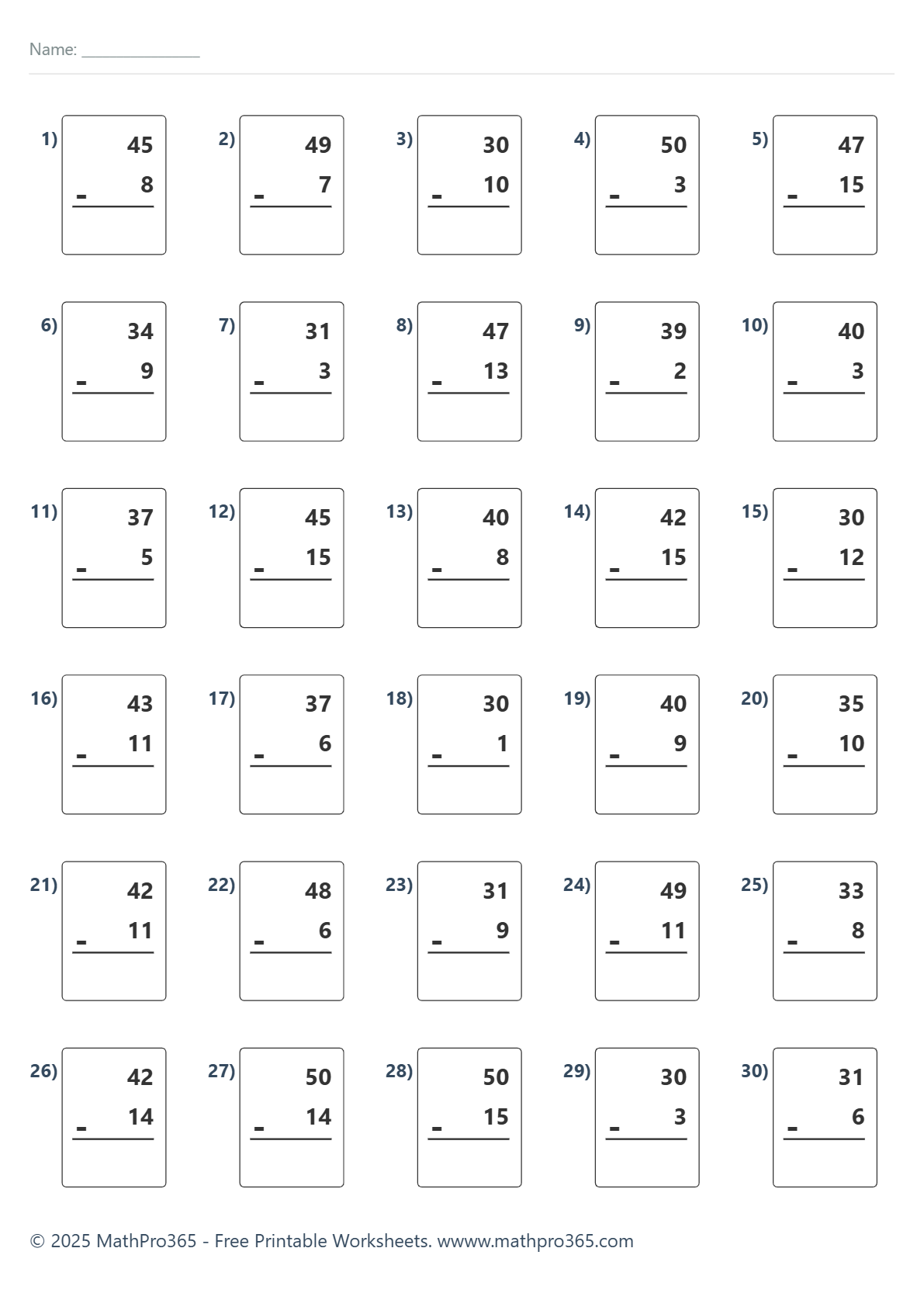
Subtraction Within 50 – 30 Practice Problems (Grade 2) – Free PDF
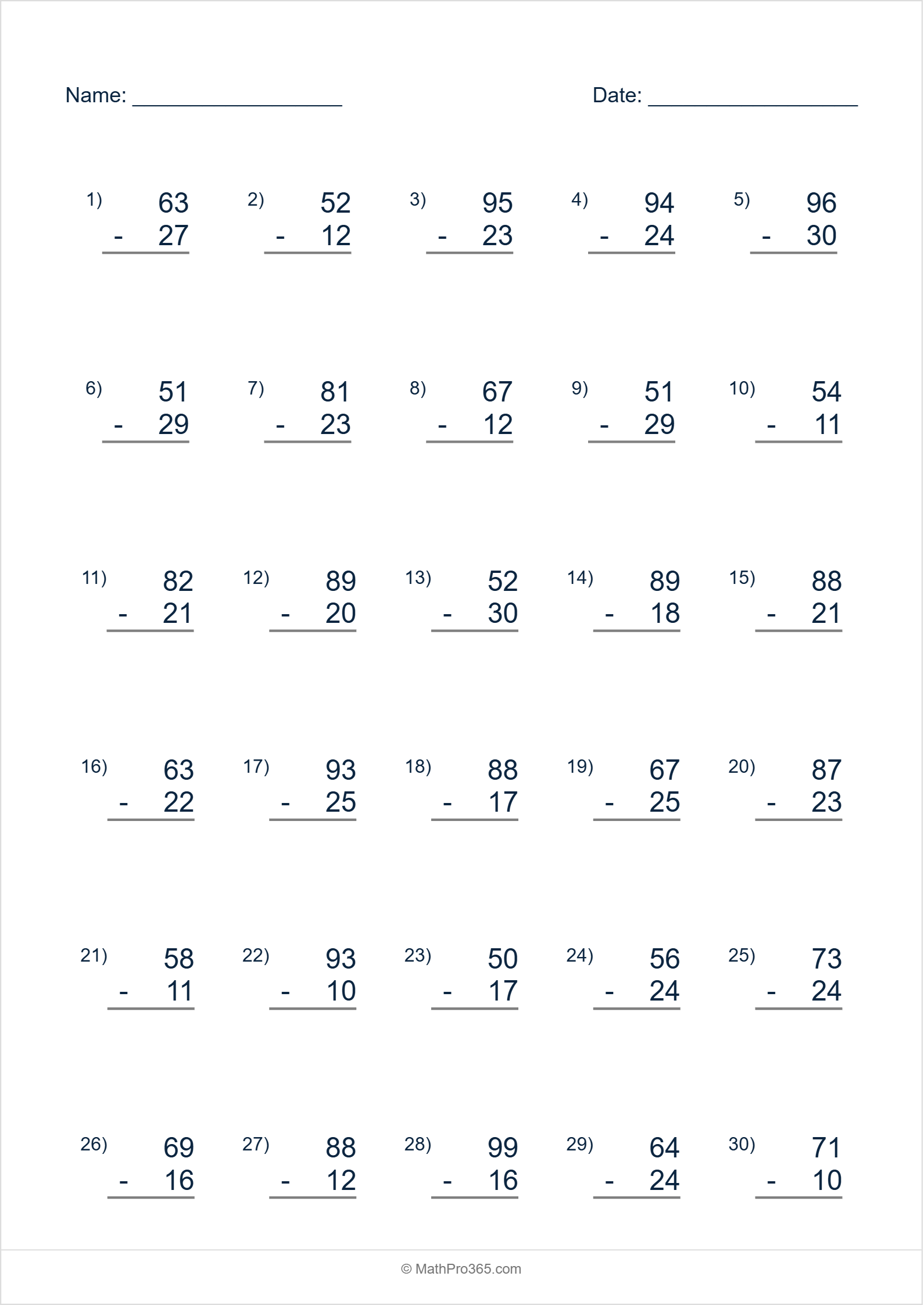
2-Digit Subtraction Practice Worksheet Grade 2 Free PDF
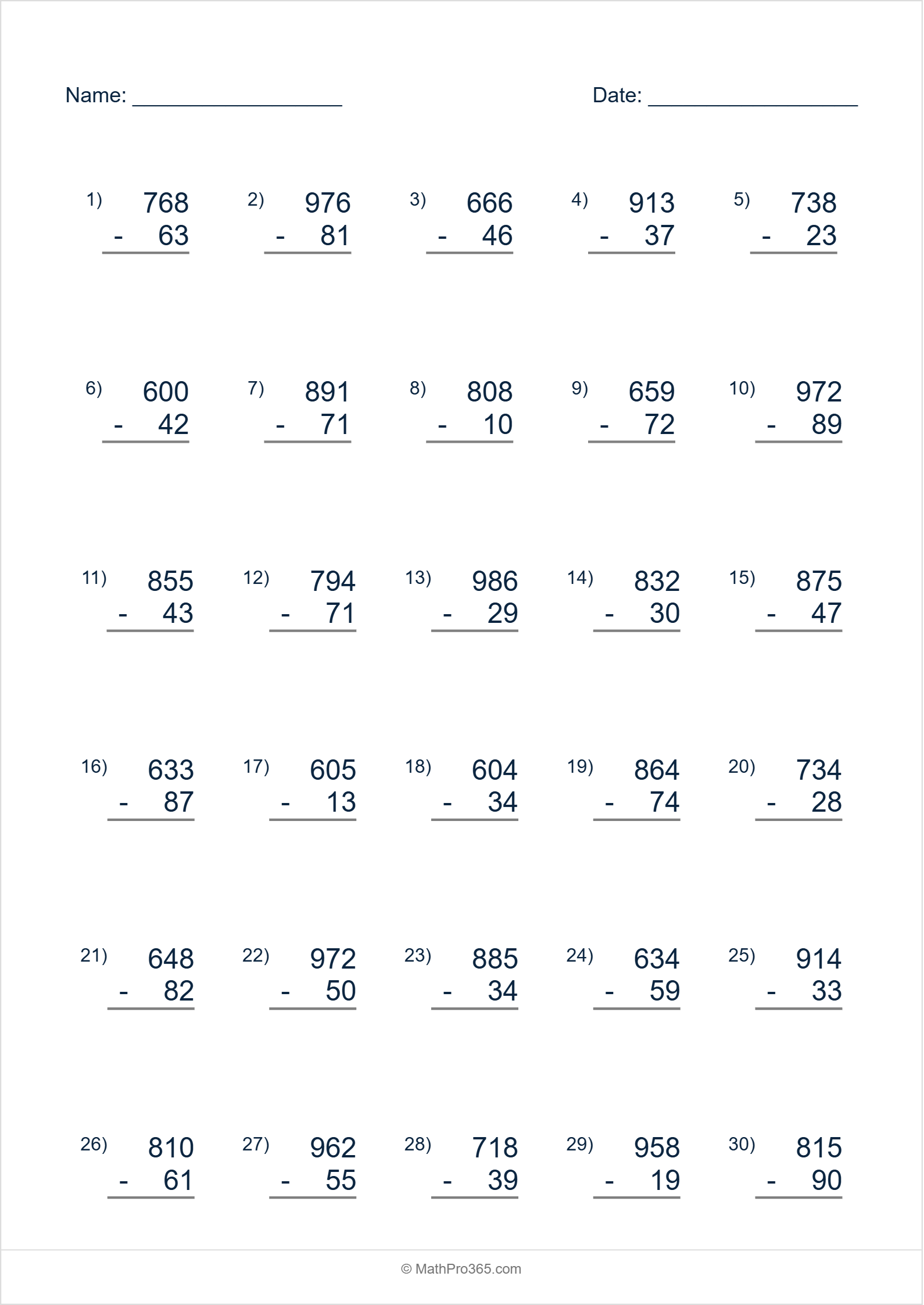
3 Digit (600-999) Minus 2 Digit (10-99) Subtraction Worksheet Grade 2 Sheet 3 Free PDF
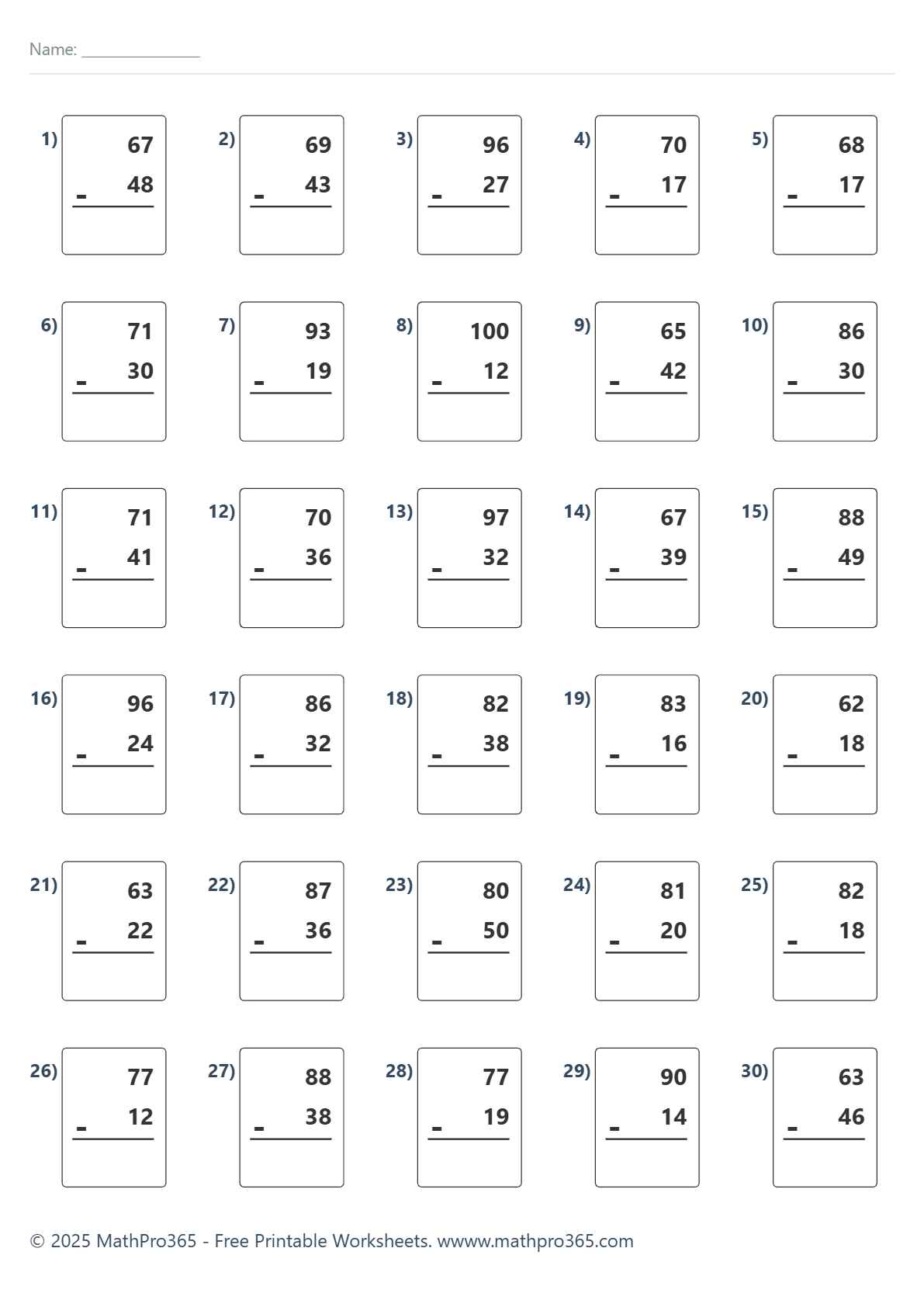
Subtraction Within 100 – 30 Practice Problems (With Regrouping) – Free PDF
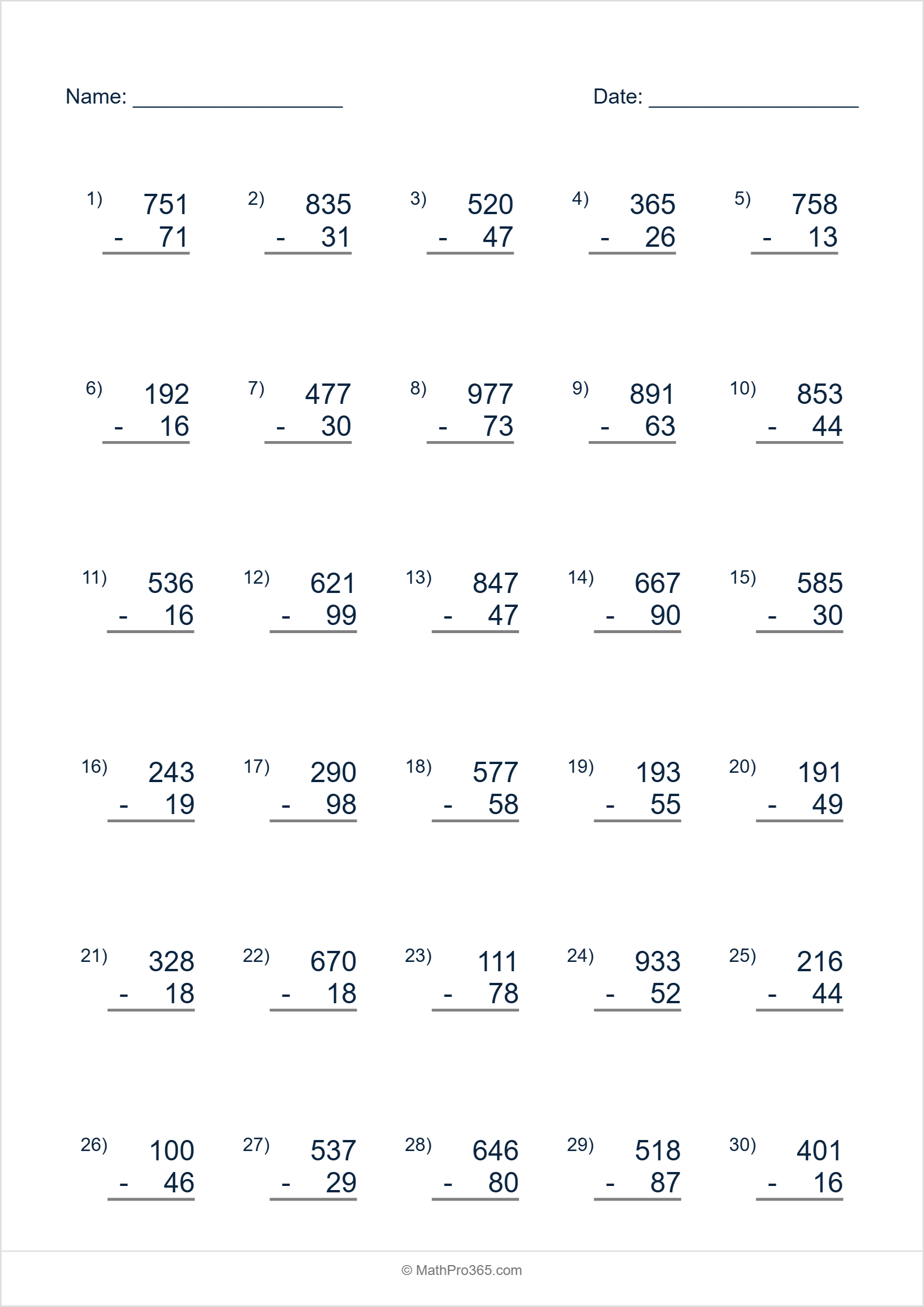
3 Digit Minus 2 Digit Subtraction Worksheet Grade 2 Free PDF
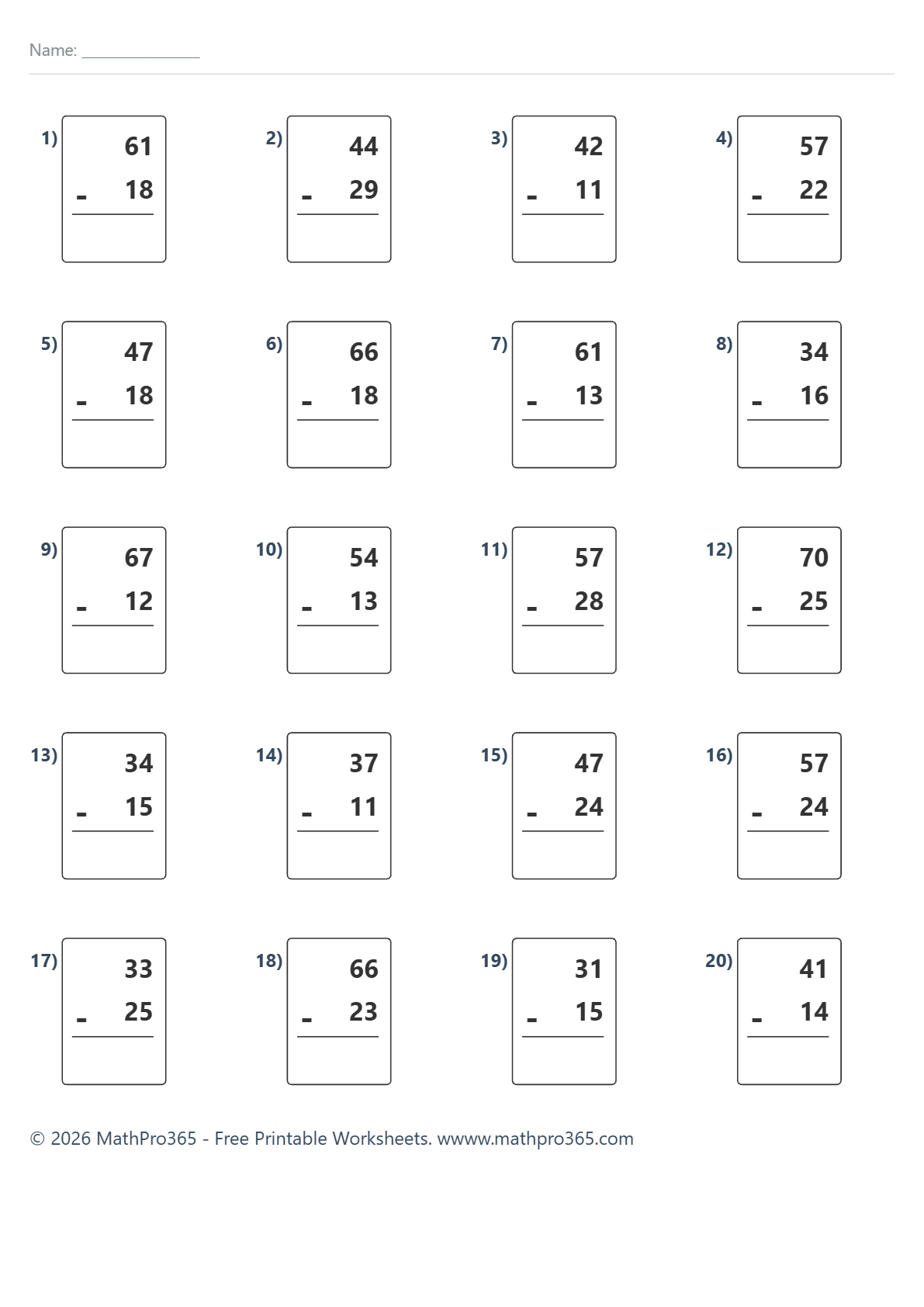
Subtraction Within 100 Basic Worksheet Grade 2 Free PDF
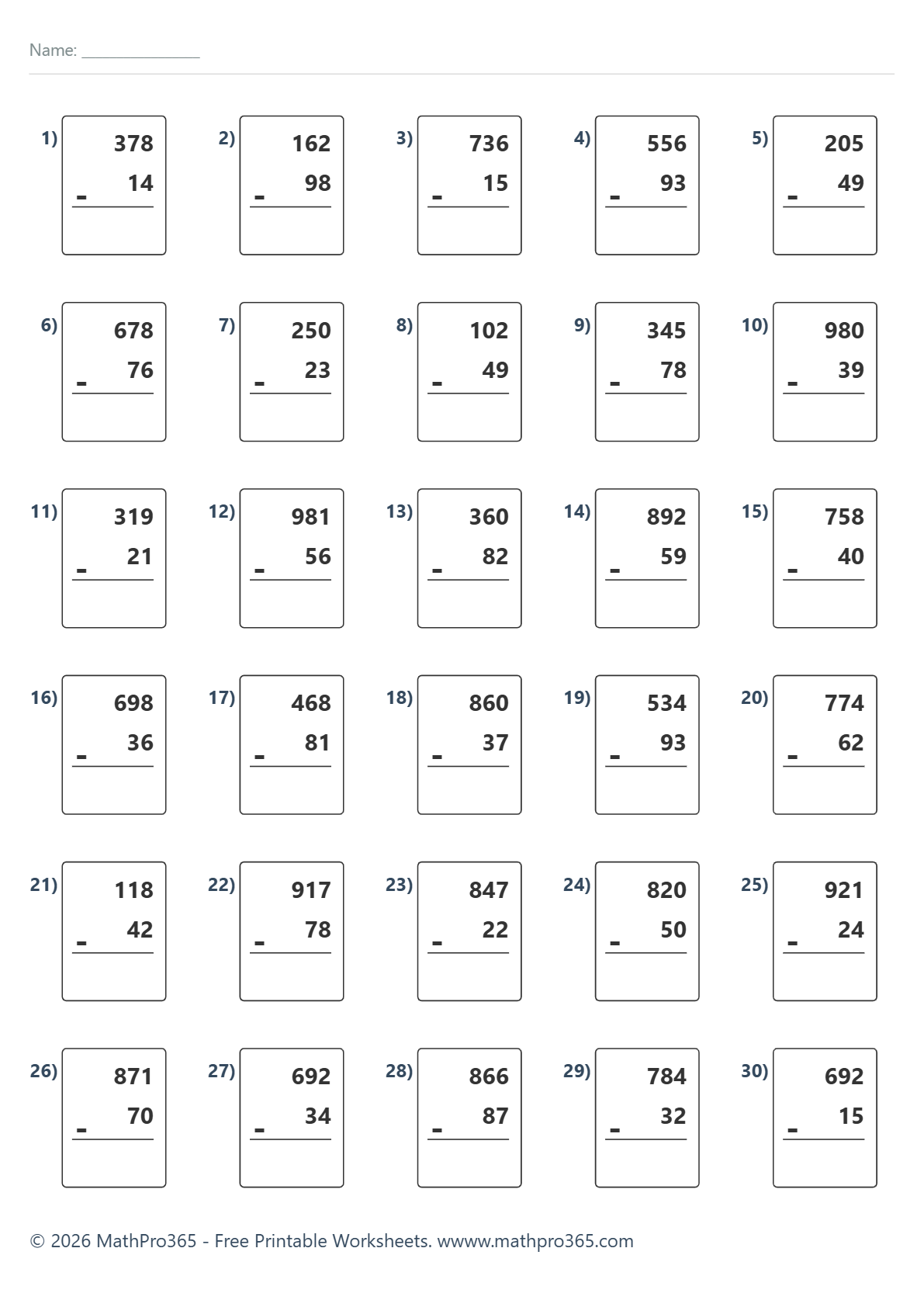
2-Digit Subtraction – 30 Practice Problems – Free PDF
Interactive worksheets can be customized before downloading.