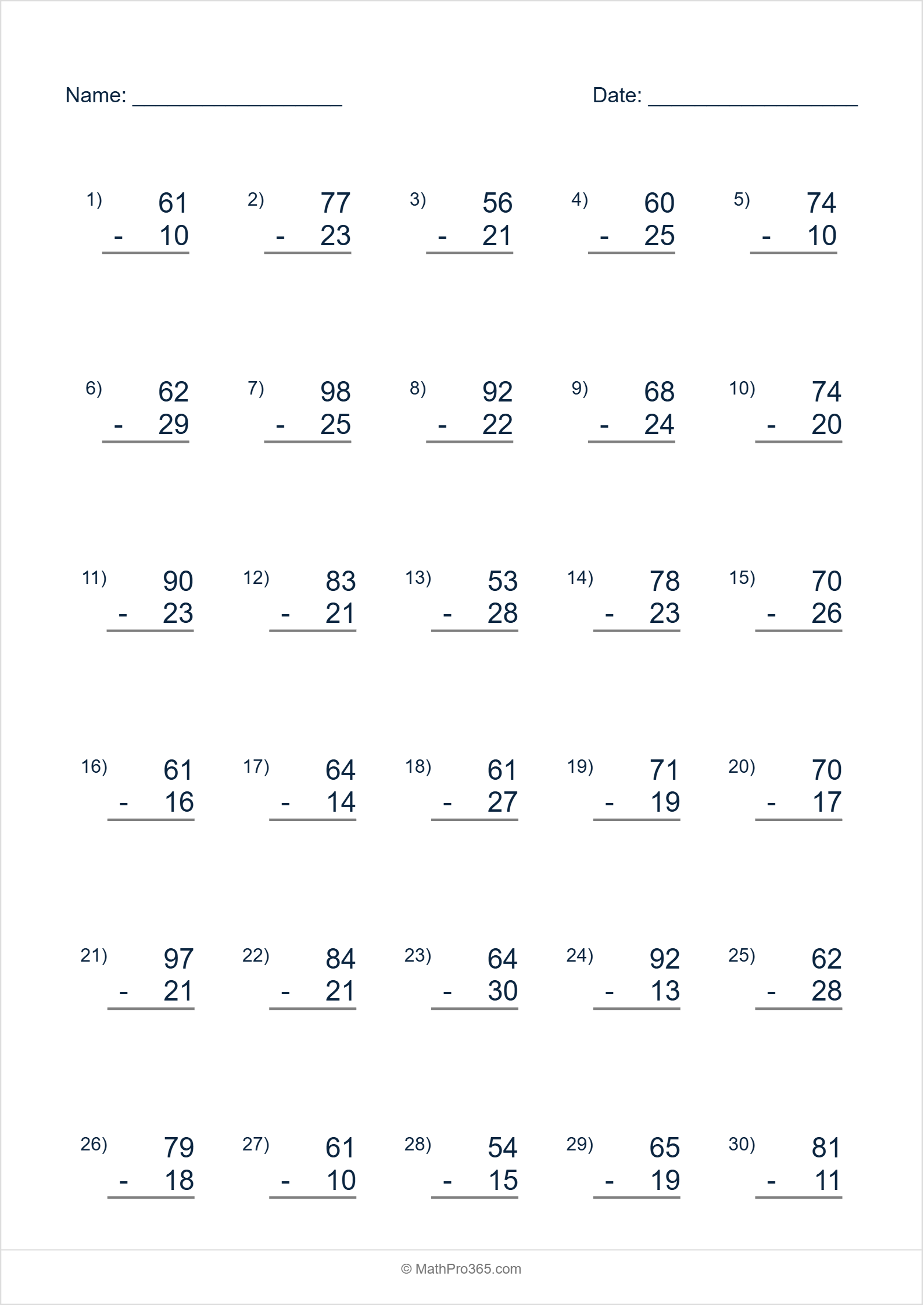
2 Digit (50-99) Minus 2 Digit (10-30) Subtraction Worksheet Grade 2 Sheet 6 Free PDF
Updated: October 2026
This printable worksheet encourages students to practice subtraction fluency while building confidence in mathematics.
More Subtraction Worksheets (Grade 2) →2 Digit (50–99) Minus 2 Digit (10–30) Subtraction Worksheet Grade 2 Sheet 6 Free PDF
Strong subtraction skills grow through steady practice, thoughtful strategies, and confidence with place value. This printable Grade 2 worksheet provides 30 subtraction problems featuring two-digit numbers from 50–99 minus two-digit numbers from 10–30, making it an excellent resource for building fluency with larger numbers. The worksheet includes a mix of questions that require straightforward subtraction as well as problems that encourage regrouping, giving children opportunities to strengthen both accuracy and mathematical reasoning. The printable layout also leaves space for students to write neatly while solving each problem. :contentReference[oaicite:0]{index=0}
Building Strong Subtraction Strategies
Children become more successful mathematicians when they understand why subtraction works instead of memorizing steps. Encourage learners to begin by identifying the tens and ones in each number. Looking carefully at place value makes every subtraction problem easier to organize.
For example:
- 61 − 10 = 51. Subtracting one group of ten changes only the tens digit.
- 74 − 10 = 64. The ones stay the same because only a ten is removed.
- 90 − 23 = 67. Subtract the ones first, then subtract the tens.
- 64 − 30 = 34. Removing three tens leaves three tens and four ones.
As children solve more examples, they begin recognizing patterns, making subtraction faster and less intimidating.
How to Use This Worksheet Effectively
This printable sheet works well in many learning environments. Teachers may include it as independent practice after a subtraction lesson, while parents and homeschool educators can use it during daily math time. Since every question stays within a carefully selected number range, learners can focus on mastering subtraction strategies without becoming overwhelmed by larger numbers.
Consider these simple teaching ideas:
- Complete the first three problems together.
- Ask children to explain each subtraction step aloud.
- Encourage neat vertical number alignment.
- Review incorrect answers together instead of simply correcting them.
- Finish by checking every answer with addition whenever possible.
These habits develop mathematical confidence alongside computational accuracy.
Understanding Regrouping
Some subtraction problems require regrouping, sometimes called borrowing. This happens when the top ones digit is smaller than the bottom ones digit.
Take the example 53 − 28.
The ones column has 3 ones, but 8 ones must be subtracted. First, regroup by exchanging one ten for ten ones. Now there are 13 ones and 4 tens. Subtract:
- 13 − 8 = 5
- 4 tens − 2 tens = 2 tens
The answer is 25.
Walking through regrouping slowly helps children understand that no numbers disappear—they are simply reorganized according to place value.
Practice Tips That Improve Accuracy
Consistent practice is more valuable than long practice sessions. Ten to fifteen focused minutes several times each week often produces better results than completing many pages at once.
Helpful habits include:
- Read each problem carefully before beginning.
- Subtract the ones column first.
- Check whether regrouping is necessary.
- Subtract the tens after finishing the ones.
- Review answers before moving to the next question.
Children who regularly check their work gradually become more independent problem solvers.
Connecting Place Value to Subtraction
Every subtraction problem is built on place value. Tens represent groups of ten, while ones represent single units. When learners recognize these groups, subtraction becomes much easier to visualize.
Consider these examples:
- 70 − 17 means starting with seven tens and removing one ten and seven ones.
- 83 − 21 removes two tens and one one.
- 92 − 13 requires regrouping before subtracting the ones.
- 98 − 25 combines regrouping with subtracting both place values correctly.
Using base-ten blocks, place value charts, or drawings can make these ideas even clearer for second-grade learners.
Encouraging Mental Math
Not every subtraction problem needs pencil and paper. Some questions can be solved mentally by noticing simple number relationships.
Examples include:
- 61 − 10 = 51
- 81 − 11 = 70
- 79 − 18 can be viewed as subtracting 20 and then adding 2 back.
- 65 − 19 can be solved by subtracting 20 to get 45, then adding 1 to reach 46.
Flexible thinking encourages children to discover multiple ways to solve the same problem while strengthening number sense.
Common Mistakes to Watch For
Even careful learners occasionally make subtraction errors. Identifying these mistakes early helps prevent confusion later.
- Subtracting the larger digit from the smaller without regrouping.
- Misaligning the tens and ones columns.
- Forgetting to reduce the tens digit after regrouping.
- Writing digits in the wrong place value.
- Rushing without checking the completed answer.
When a mistake occurs, encourage children to retrace each subtraction step rather than erase everything immediately. This approach strengthens mathematical reasoning.
Making Practice More Enjoyable
Subtraction practice does not have to feel repetitive. Small activities can add excitement while reinforcing important skills.
Try timing one row of problems to build fluency, using colorful pencils to highlight regrouping steps, or allowing children to explain one completed problem like a teacher. Another fun challenge is asking learners to predict which problems require regrouping before solving them. These simple variations keep practice fresh while supporting deeper understanding.
Frequently Asked Questions
1. Is this worksheet appropriate for Grade 2 learners?
Yes. The problems match common Grade 2 subtraction expectations by using two-digit numbers between 50–99 and 10–30. The mix of regrouping and non-regrouping questions provides an appropriate level of challenge.
2. Should children use manipulatives before solving independently?
Absolutely. Base-ten blocks, place value charts, counters, or drawings help children visualize regrouping and understand what happens during subtraction before relying on written algorithms.
3. How often should children complete worksheets like this?
Completing one worksheet two or three times each week is usually enough to build fluency. Regular short practice sessions encourage better retention than occasional long sessions.
4. What is the best way to check completed answers?
A simple strategy is to use addition. Add the answer to the number that was subtracted. If the sum matches the starting number, the subtraction is correct. This reinforces the relationship between addition and subtraction.
Download and Print
Print this Grade 2 subtraction worksheet for classroom lessons, homeschool instruction, tutoring sessions, homework, math centers, or extra practice at home. With 30 carefully selected two-digit subtraction problems covering numbers from 50–99 minus 10–30, children gain valuable experience with place value, regrouping, mental math, and accurate written subtraction. Regular practice using printable worksheets like this helps build confidence, improve speed, and develop lasting subtraction skills that prepare learners for more advanced mathematics. :contentReference[oaicite:1]{index=1}
Worksheet Preview
Today's Challenge
Frequently Asked Questions
Who is this worksheet for?
This worksheet is designed for Grade 2 students practicing subtraction skills.
Can I print this worksheet?
Yes. The worksheet is available as a printable PDF download.
Can teachers use this worksheet in class?
Yes. Teachers, homeschool users and parents can use it for classroom practice and homework.
Related Worksheets
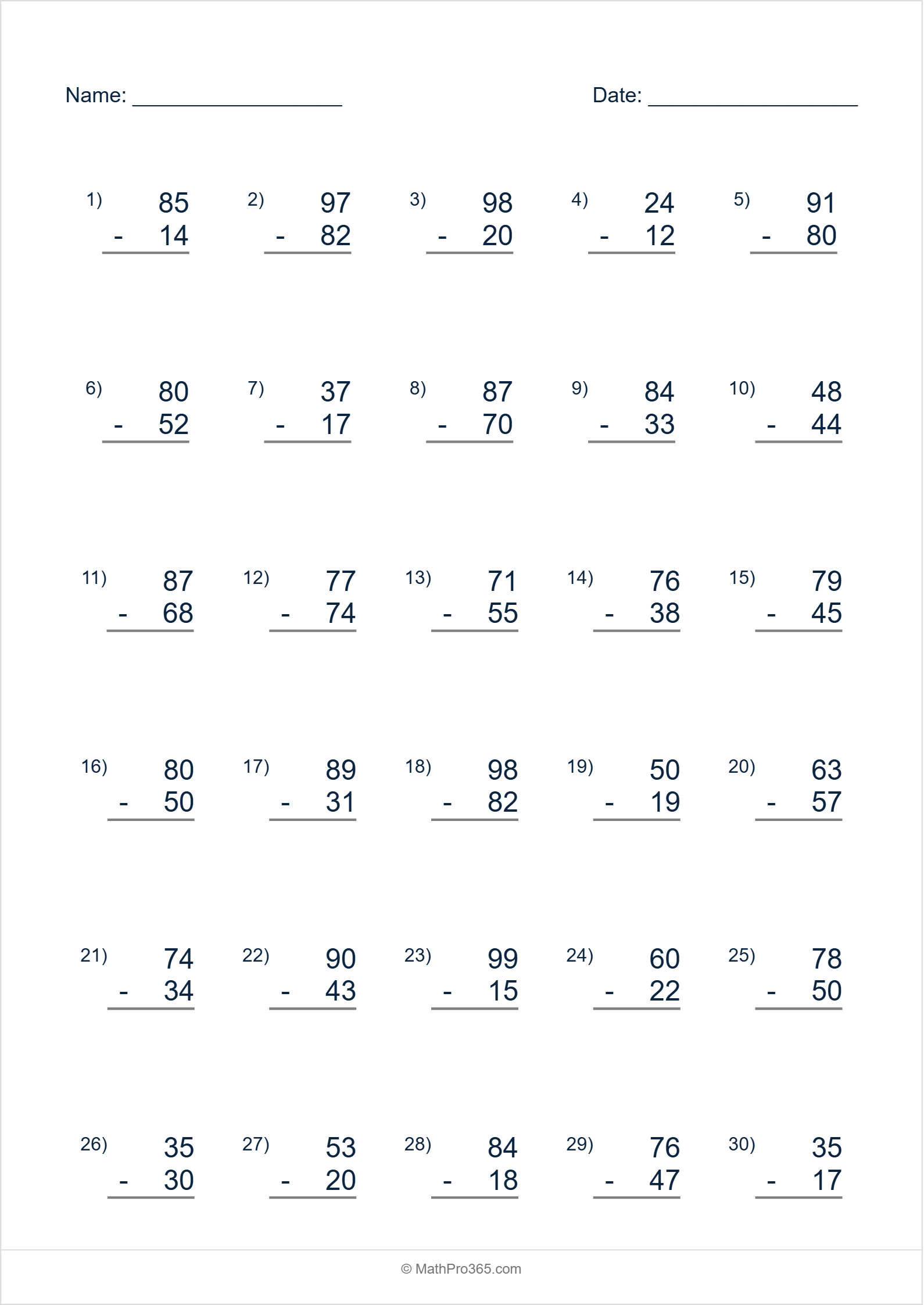
2 Digit Minus 2 Digit Subtraction Worksheet Grade 2 Free PDF
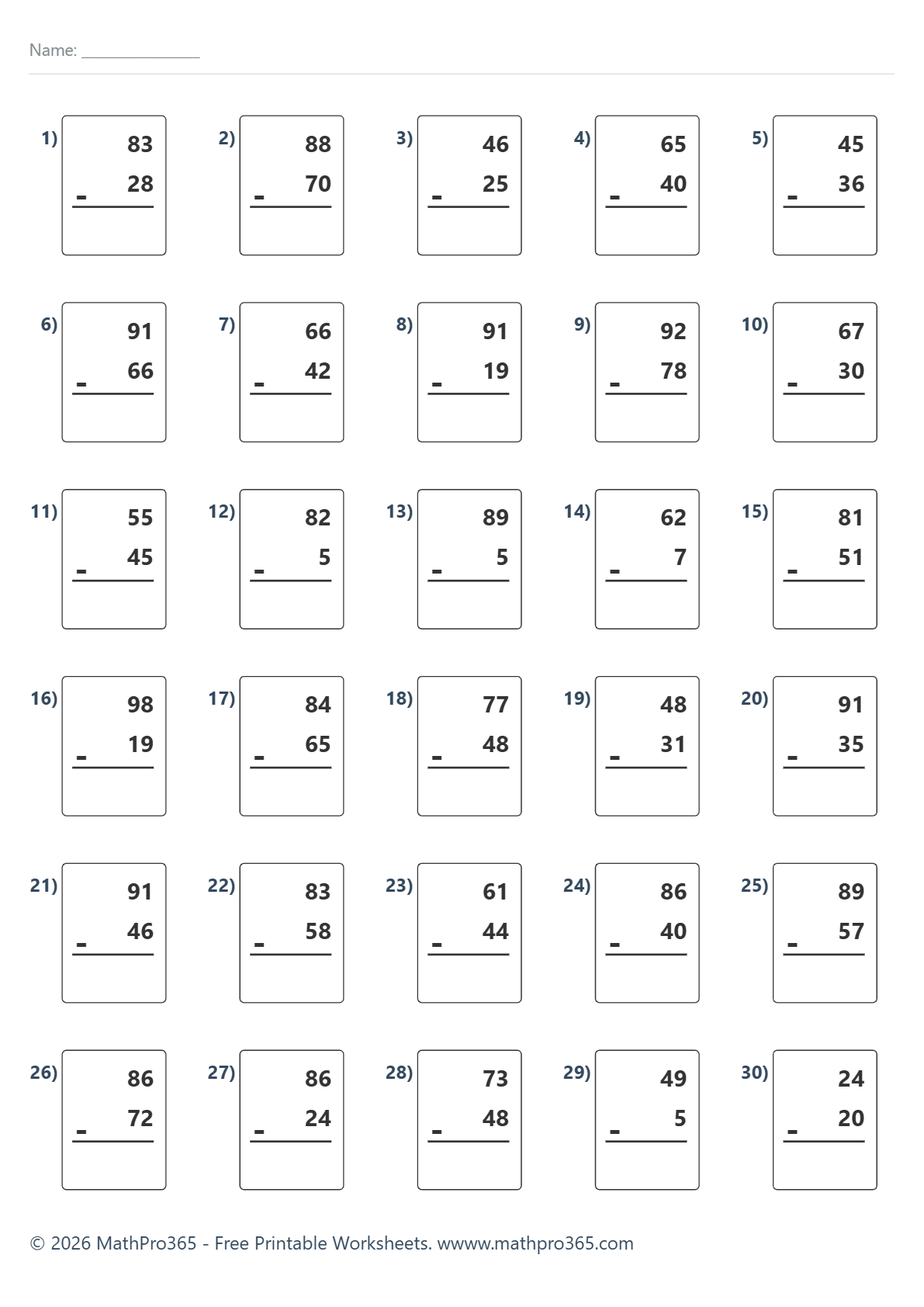
Subtraction Within 100 – 30 Practice Problems (With Regrouping) – Free PDF
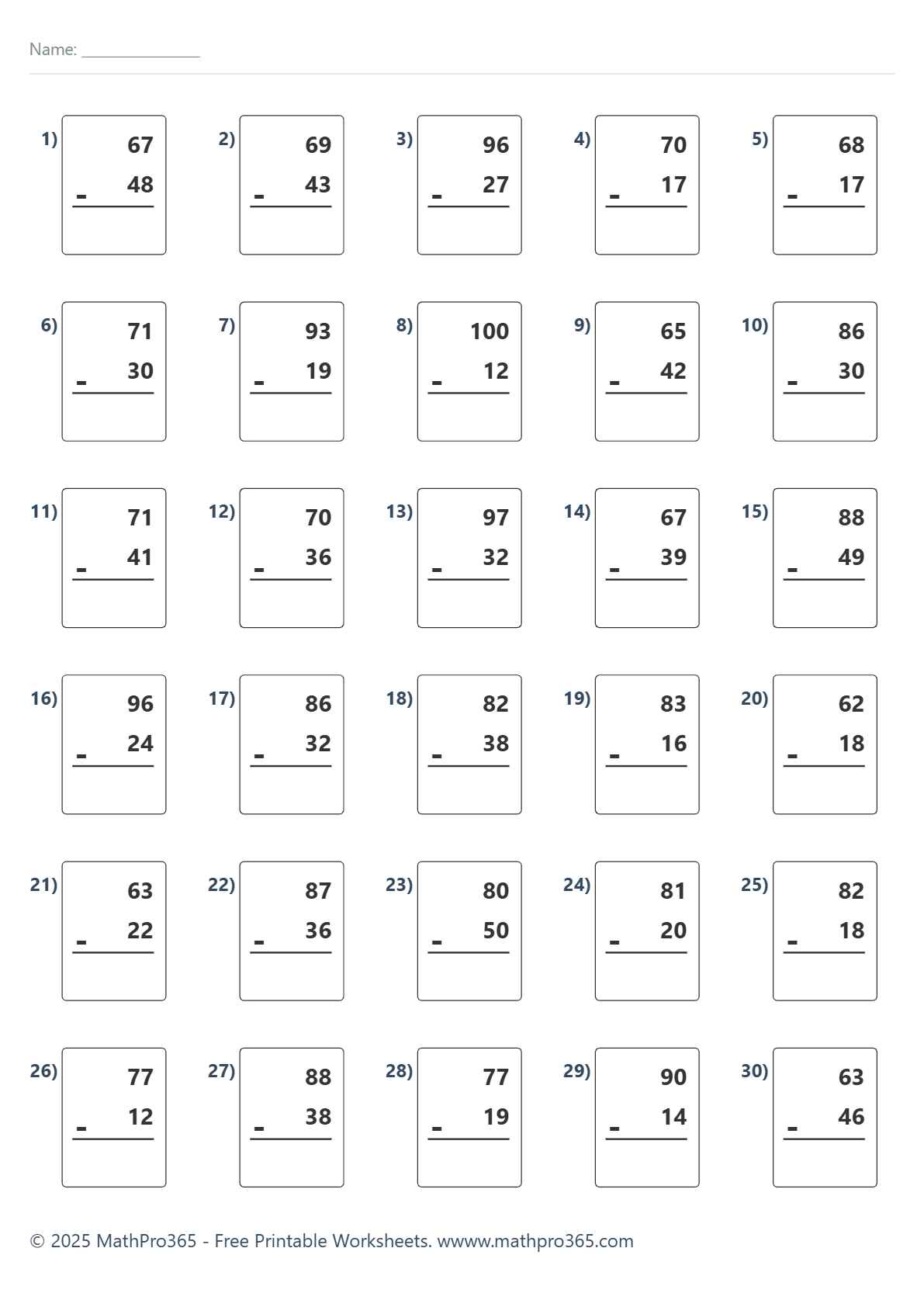
Subtraction Within 100 – 30 Practice Problems (With Regrouping) – Free PDF
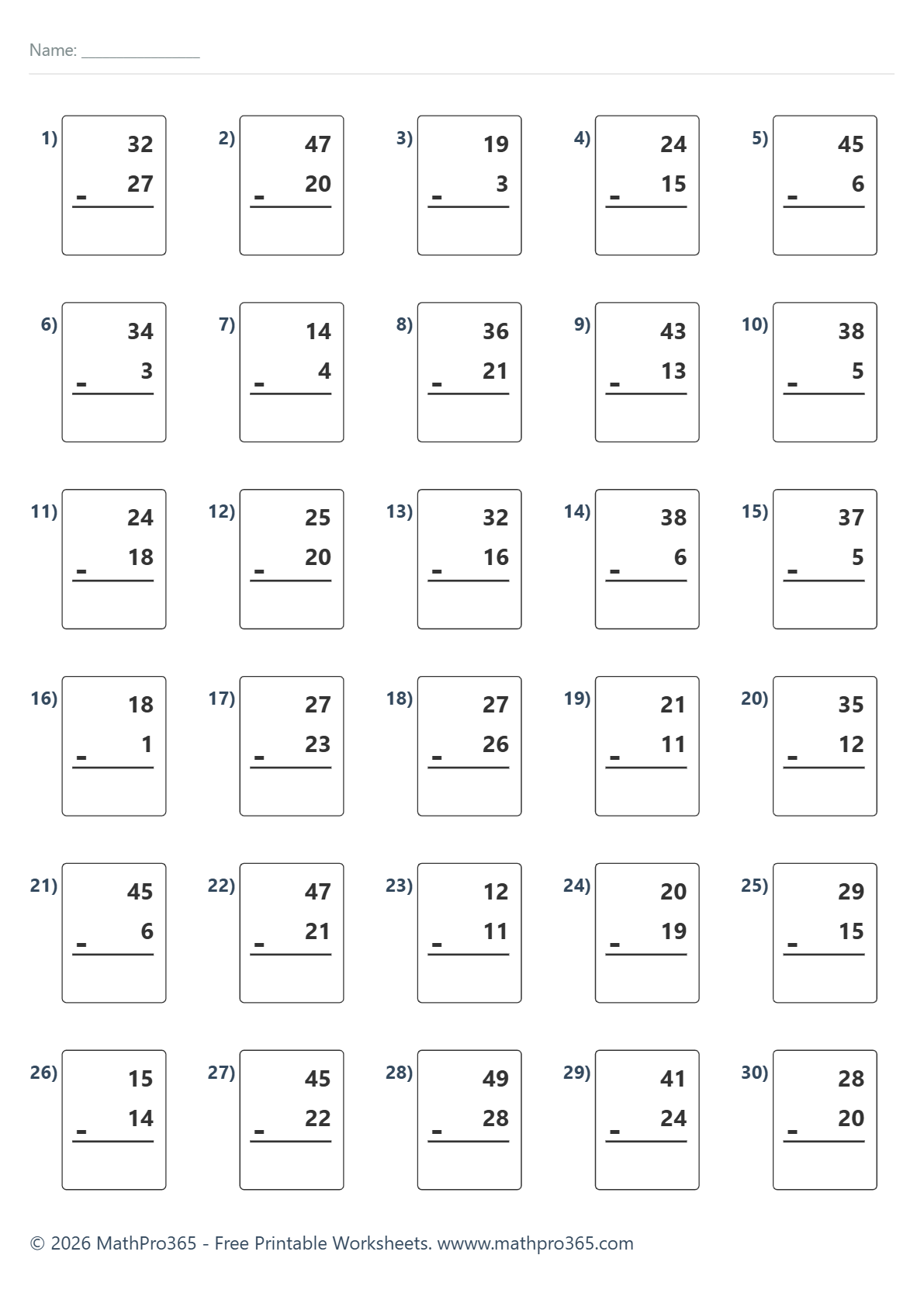
Subtraction Within 50 – 30 Practice Problems (Grade 2) – Free PDF
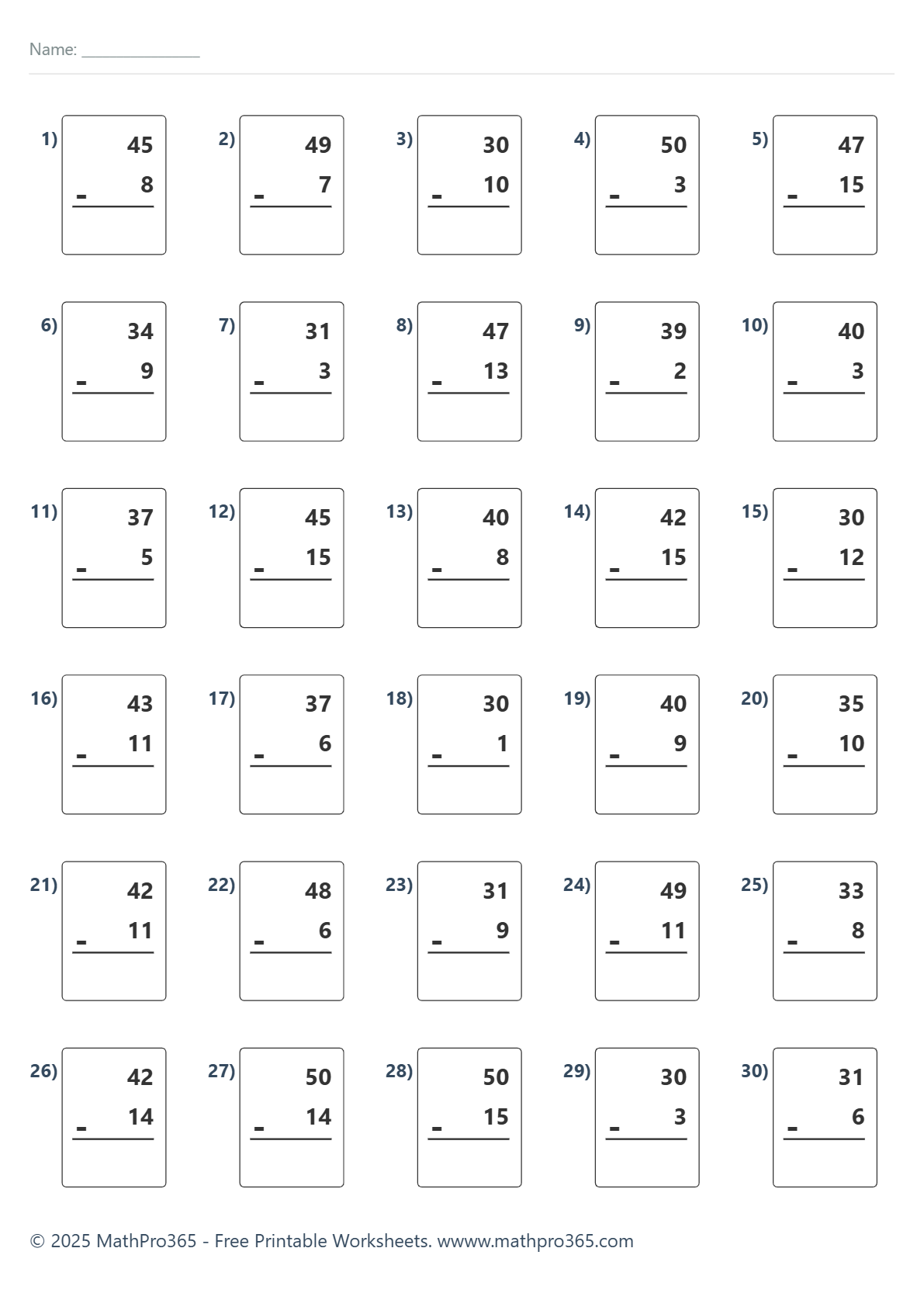
Subtraction Within 50 – 30 Practice Problems (Grade 2) – Free PDF
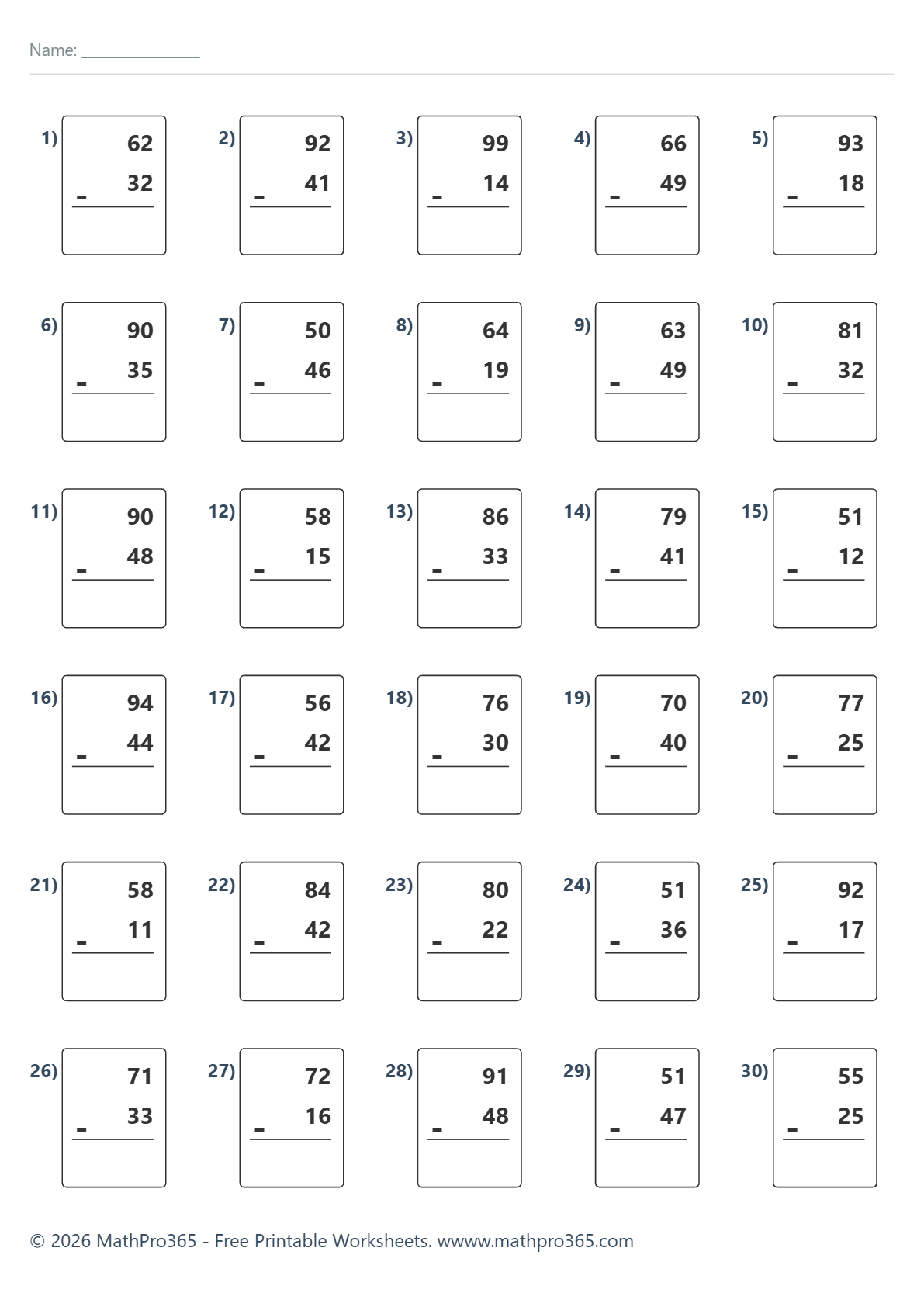
Two Digit Subtraction with and without Regrouping Grade 2 Free PDF
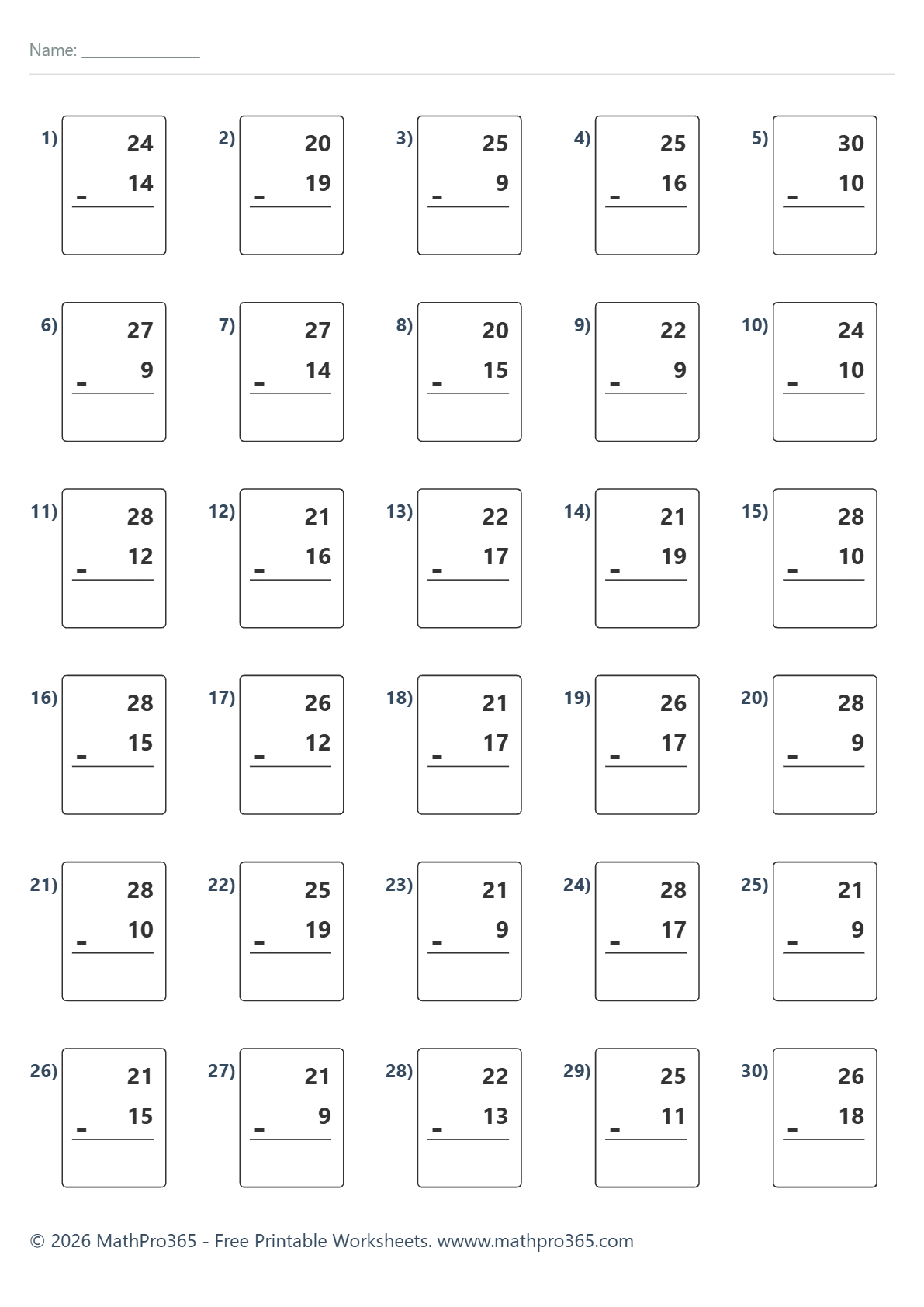
2-Digit Subtraction with Regrouping Grade 2 Free PDF
Grade 2 Double Digit Subtraction Worksheet
3 Digit Minus 2 Digit Subtraction Worksheet Grade 2 Free PDF
Subtraction Within 100 Basic Worksheet Grade 2 Free PDF
Interactive worksheets can be customized before downloading.